Showing posts with label music. Show all posts

Monday, November 19, 2018

BLAZEDMADE INTERVIEW: ITHAKA DARIN PAPPAS (PART 1/2)

BLAZEDMADE INTERVIEW: ITHAKA DARIN PAPPAS (PART 1/2)

BLAZEDMADE INTERVIEW: ITHAKA DARIN PAPPAS (PART 1/2)
August 31, 2018
Welcome to The Blazedmade Interview. Here we bring you exclusive, intimate and engaging conversations with those who live at the intersection of hip-hop, fashion and culture. From artists and producers to choreographers and creative directors, we pull back the curtain on raps' icons and unsung heroes, past and present.
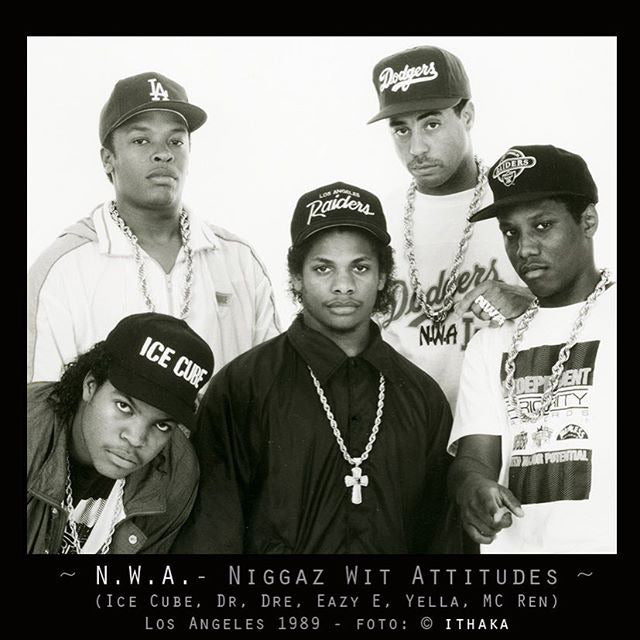
We’re thrilled to kick things off with Ithaka Darin Pappas, who in 1988, was annointed N.W.A's official photographer by the groups label/distributor Priority Records.
Blazedmade founder Daniel Cutler spoke with Ithaka at his home in L.A. where the photographer-artist-surfer detailed the unknown story behind his iconic N.W.A "Miracle Mile” shot, an increasingly important image in the history of hip-hop. 
The two also discussed the day skateboarding went gangsta rap, and how, unbelievably, over 70% of Ithaka's N.W.A photos have never actually been seen. 
BM: Where are you from and where did you grow up? 
IDP: I’m from southern California, lived between and LA and Orange Country most of my life. 
BM: When did you start getting in to photography? 
IDP: I’ve always been in to it. My dad was a devout hobbyist, I’ve been shooting photos since I was five years old. I sold my first picture when I was 17 years old. 
BM: Who for? 
IDP:  Independent - a skateboard brand. In 1984 I think.
BM: Sure I know Independent. Did you skate?  
IDP: I’m a surfer. I was really just photographing skateboarders. I skate but I was much more behind the camera in that activity, whereas in surfing I was not behind the camera at all. 

N.W.A Miracle Mile photographed by Ithaka Darin Pappas, Los Angeles, 1988.
BM: What is this photo known as? When and where was it taken? 
IDP: This photo is known as The Miracle Mile. It was my first time photographing N.W.A and my first time shooting for Priority Records. It was intended to be the shoot for the cover of Eazy-E’s single “We Want Eazy". We were also trying to get publicity photos of N.W.A, as a group, which I didn’t get a whole lot of that day. We were also doing some publicity photos for Big Lady and she came by the shoot also. 
BM: As in Big Lady K? 
IDP: Yeah. She’s a rapper, half-Guatemalan, half-black from Riverside. She was fifteen at the time. An amazing talent. 
There was no directing anybody. They come self-contained. You can pare down the shoot to a point, but everybody's individual personality is so strong, they're not very moldable. 
BM: How did you land the gig? How did you connect with Priority? 
IDP: It was completely by coincidence. I was already shooting stuff in the entertainment world, mostly young, teeny bopper stuff. I was looking for something edgier. One day I was skateboarding down my street, in an area known as the Miracle Mile, and a neighbor of mine pulls up in the driveway next to mine with a ton of groceries, and I asked if she needed some help. It turned out to be one of the Marketing Directors at Priority. She invited me to go show my book to the Art Director over there. So the next week I went in to show my book to the director, Elaine Friedman, and it worked out. 
BM: That’s so random. 
IDP: Yeah - and I was totally an N.W.A fan. Gangsta Gangsta was blowing up K-Day which was the main radio station at the time. I mean, I was really listening to this stuff a lot. Then suddenly these guys (N.W.A) were in my living room a couple weeks later. It was pretty cool. 
BM: What year was this? 
IDP: This was November of 1988, I think it was November 11th. It was around the near simultaneous release of Straight Outta Comptonand Eazy’s first album (Eazy-Duz-It), they came out almost the same time. It was like a grand slam, it was pretty crazy, they were everywhere!

Eazy-E, Big Lady K and N.W.A "Miracle Mile" Contact Sheet, courtesy of Ithaka Darin Pappas.

BM:  Yeah, they were released a month apart I believe.
IDP: Yeah, I just remember Eazy and everybody rolling up to my place, which was in a really quiet semi-elderly Jewish neighborhood. They roll up in a GMC Safari, and they were just blasting the music! The neighbors were like “what’s going on?” It was great because I couldn’t stand my landlord at the time. 
BM: Ha! No one’s going to mess with you in that scenario.  
DP:  Yeah, yeah. It was fun.
BM: Where on the N.W.A timeline did the Miracle Mile shoot take place? Were they mostly an L.A. thing at this point? Or was it bigger than that? 
IDP: Well, I was only in L.A. so I don’t know. But in L.A. they were absolute underground legend status already. I don’t know how much mainstream people really knew about them, but in my world they were already household names after just six or seven months. [Ithaka chooses his words carefully] It was just such a raw…I think the thing that set this project apart…people that live in the suburbs were really aware of…I heard Cube say like a hundred times that N.W.A were street reporters, and nothing could be more accurate. At that time, all the violence happening was really behind the curtain. N.W.A brought us this slice of another reality, their reality, and it was really eye opening for a lot of people, myself included. 
BM: Yeah, me too. So explain how the shoot went down. Did they hand over the reigns to you as the director? Did they take your direction?
IDP: There was no directing anybody. They come self-contained. You can pare down the shoot to a point, but everybody’s individual personality is so strong, they’re not very moldable. It was their time, it was their world. I was more a fly on the wall, trying to capture what they were all about. I was trying to record who they were. 
BM: So this iconic image of gangsta rap's founding fathers was shot in your apartment? 
IDP: Yeah, at 65** 1/2 Orange Street, L.A., Wilshire and San Vincente. Near the Museum Row area. They just came over. One thing I had noticed, even at this early point, was that there weren’t a lot of clean shots of them together. They were either riding, in the street, on the move, in sunglasses. It was hard to see what they looked like. For this shoot, I was just trying to show their faces. Like I was shooting for a fashion magazine. It was shot in my apartment with a couple of studio strobe heads. I had rented a Hasselblad camera, a high end camera. These were smaller budget shoots, the entire budget for that day was maybe five hundred dollars and that was to include film and everything. I spent way more than that because I wanted to do a good job. These were people whose music I loved and people who I admired. I didn’t know if I was ever going to shoot them again. I wanted to do a kick-ass job first time around. 
BM: So you sensed that this could be a game changer for your career?  
IDP: Yeah, I mean I had no idea they were going to blow up to become, you know, millennial figures. I had no idea it was going to go that large, but I knew this was something special. 
BM: So what where they like? Describe their individual vibes.
DP: They were definitely tough guys, but also very funny, especially amongst themselves. Super funny cats. 
BM: Yeah, I hung out with Eazy a couple times and he was fucking funny! I don’t think people realize how huge a role humour played in his personality.
IDP: Yeah, Eazy had an incredible sense of humor. He had absolute star quality. And he was also extremely easy to photograph. Out of the entire group he was the easiest. I mean he was so stylized, and he was just easy to work with. I found Dre to be pretty shy, photographically. Eazy was a clown, a funny guy. Ren was really tough. Yella was really nice. Cube was serious and determined, his intelligence absolutely permeated, really obvious, I could tell how high the guys IQ was after just a three minute conversation. Then I think we ended getting a bunch of nachos and drank old English. It got loud, it was fun. 
BM: What was your relationship like with the guys at the start? 
DP: (Laughing) No one really remembered my name.They just called me “the camera man”. 
BM: I guess it’s obvious why.
DP: Well, we were shooting and the music was on, it was really loud. I was kind of standing on a stool, dancing to the music a bit, and Ren kinda pointed at me and smiled and said “check out the cameraman”. From then on i was “the cameraman”. I don’t think anybody called me anything but that from then on.
BM: How many sessions did you shoot with N.W.A? Over what period of time? 
DP: Well beginning in ’88 and ’89’, ’90...and I shot Ice Cube I think in ’91. So I would say three years. Photographing them every two months. I would say it was a about three years. I think eighteen to twenty shoots total.
BM: Wow. So you had this access to them from the very start, through their break-up, and afterwards? 
DP: Yeah and that was interesting too, because you know, arriving that first day, there was probably some live shows, nobody was really getting paid yet. Then two months later, people are driving nice cars. It was interesting to see it from a distance. I didn’t consider myself a friend, we didn’t really hang out, other than the Malibu “Wild and Wet party” but I would see them periodically and they were really getting famous so i would see, not really a difference in behaviour, but the accessories got a lot nicer! 
BM: No doubt! So over the period that you shot them they were going through a lot of internal conflict. Were they still together the last time you shot them? 
IDP: No, the last time I worked with N.W.A as a group Cube had already split. I worked with Cube a few times on his own projects, for video shoots and UK music magazines. That was as far as I got, I didn’t see Dre leave the group. I had moved back to Portugal by that time. 
BM: Did you shoot Dre solo as well? 
IDP: Not really. I mean I shot him by himself as a member of N.W.A. I would always pull people aside for little shoots. I did that with Dre. It was very improvisational. The one record cover that I shot, the only time we ever really had a layout, was for the We Want Eazy 12” cover. Everything else was “go out with the guys, get what you get".  One of those images, a bleacher shot in McArthur Park, ended up as the cover for the Express Yourself (single) and Straight Outta Compton maxi-single cover. Mostly I would just try to pull people aside and get a few shots. In a way it kind of dictated my whole style of photography from then on, because I was so limited on time with everybody that it made me work faster and try to come up with things on the fly that professionally looked like studio set-ups but with natural light and trying to keep a wall, you know, so I’m kind of thankful for that experience. It was like guerrilla shooting. 
BM: What equipment were you shooting on over those eighteen shoots? Was it one main camera? 
IDP: I shot the Miracle Mile image on medium format Hasselblad. Most of the other shoots were on Nikon 250 FE, you know just a standard camera. It was photojournalism. I was just trying to get portraits. But that first shoot (Miracle Mile) I shot that on medium format ultra high quality. It was a camera I used for my actor shoots, I was already familiar using it in the studio so that’s what I brought to that shoot. I rented all the gear and we shot it in my living room. 
BM: You also shot a series of photos with Eazy-E in Venice, skateboarding, which have become quite iconic. Can you tell me about those? 
END PART ONE.

Source: https://blazedmade.com/blogs/news/interview-ithaka-darin-pappas
Links:
https://www.discogs.com/artist/468212-ITHAKA
https://www.youtube.com/channel/UCIZXy50yj_t9UuHqeOQhpGQ
http://planetithaka.blogspot.com/
https://genius.com/artists/Ithaka
https://en.wikipedia.org/wiki/Ithaka_Darin_Pappas
http://ithakaofficial.com/
https://www.facebook.com/IthakaBlue/
https://itunes.apple.com/us/artist/ithaka/69363540
https://store.cdbaby.com/artist/Ithaka2
https://www.instagram.com/_ithaka_/?hl=en
https://www.imdb.com/name/nm5225987/
https://thehundreds.com/blogs/content/ithaka-interview
https://pt.wikipedia.org/wiki/Ithaka


http://upmagazine-tap.com/en/pt_artigos/ithaka-2/

Wednesday, May 30, 2018

Ithaka "The Plot" Album: Fishdaddy Flashbacks


Ithaka "The Plot" Album: Fishdaddy Flashbacks


___________________

Links:
https://www.discogs.com/artist/468212-ITHAKA
https://www.youtube.com/channel/UCIZXy50yj_t9UuHqeOQhpGQ
http://planetithaka.blogspot.com/
https://genius.com/artists/Ithaka
https://en.wikipedia.org/wiki/Ithaka_Darin_Pappas
http://ithakaofficial.com/
https://www.facebook.com/IthakaBlue/
https://itunes.apple.com/us/artist/ithaka/69363540
https://store.cdbaby.com/artist/Ithaka2
https://www.instagram.com/_ithaka_/?hl=en
https://www.imdb.com/name/nm5225987/
https://thehundreds.com/blogs/content/ithaka-interview
https://pt.wikipedia.org/wiki/Ithaka
http://upmagazine-tap.com/en/pt_artigos/ithaka-2/

Thursday, October 5, 2017

Flowers And The Color Of Paint - Ithaka


Although written and vocalized in the English language by Ithaka Darin Pappas, a southern-Californian, this record (his debut album) was recorded in Lisbon, Portugal (where the artist lived from 1992-1998) and where, to most, this is considered a 'Portuguese' album.

This record appeared in the middle of a new movement known as Hip Hop Tuga (hip hop made in Portugal). Many hip hop tuga artists were from former colonies of Portugal in Africa such as; Cape Verde, Mozambique and Angola - and Ithaka was not considered an outsider with this national and international group of lyricists/vocalists.

The recordings include guest appearances by many of the best young performers working in Portugal at that time, such as General D and Marta Dias. The album was very well received by the media, being nominated nominated for three Blitz Premios (Portuguese equivalent to the Grammy): "Best New Artist", "Best Male Vocalist" and "Best Album". And in a 1999 retrospective of Portuguese music by the national newspaper Publico, "Flowers And The Color Of Paint" was considered one of the most important "Portuguese" albums of the 1990s.

The record is perhaps best known internationally because of the track, Escape From The City Of Angels, which came to public light when award-winning film director Antoine Fuqua used the song in his movie "The Replacement Killers" during a sequence featuring critically acclaimed actors Mira Sorvino, Chow Yun fat and Clifton Collin Jr.


Saturday, April 8, 2017

Ithaka: lyricist, vocalist, and producer


"Fascinating lyricist, vocalist, and producer who doesn't seem to restrict himself to any specific genres. His 1993 acapella masterpiece, "So Get Up", (which was first remixed by Underground Sound Of Lisbon in 1994), has gone on to become one of the most mixed and memorable EDM vocals of the last two-and-a-half decades. It was most recently popularized by trance superstars, Cosmic Gate.

Ithaka's original "So Get Up" lyric and vocal have appeared in more than a thousand (yes, A Thousand !) tracks around the globe - in a wide range of sonic styles including; House, Progressive House, Electro House, Deep House, Tech House, UK Garage, Trance, Uplifting Trance, Techno, Hardcore, Dutch Hardcore, Gabber, Drum and Bass, Breakbeat, Dubstep, Synthpop, Trip hop, Hip hop, Downtempo, Nu jazz , Ambient, Rock and Art Rock.

His eight solo albums have, for the most part, a chilled-out story-telling kind of hip hop/trip hop vibe. One of the records, Voiceless Blue Raven, is all instrumental. And another, So Get Up & The Lost Acapellas, is almost entirely vocal...returning once again to his roots as a spoken-word poet.

His song "Escape from the City of Angels" from the album, Fishdaddy Flashbacks was used in the soundtrack to Antoine Fuqua's feature film, The Replacement Killers, starring Chow Yun Fat and Mira Sorvino (released by Columbia Pictures)."

http://www.whosampled.com/Ithaka/

Sunday, March 26, 2017

Ithaka: "Who Made The Grass Green?" [Album: So Get Up & The Lost Acapellas]


Ithaka: 

"Who Made The Grass Green?" 


Evolution is a fact,

it's been proven true.


But who provided the first cell

that split in two?


Who made the grass green?

The sky and the sea blue ?


----------------------------


Ithaka Darin Pappas © 1992

Written in Lisbon Portugal (1992)
Recorded in Manchester (1993)

[Sweatlodge Records]


............................

Friday, March 10, 2017

Ithaka : So Get Up & The Lost Acapellas


ithaka : So Get Up & The Lost Acapellas


Collection of vocal poems recorded in Europe in 1993, which had been completely lost until being rediscovered in early 2017 (on a damaged cassette tape in a Los Angeles garage). These are the companion works for the iconic, So Get Up.

 https://www.cdbaby.com/cd/ithaka2

Californian-born writer and vocalist Ithaka (aka Ithaka Darin Pappas) relocated from his native Los Angeles in 1992 to Europe where the artist entered of six year period of hyper-creativity. There he wrote, vocalized, created sculptures and photographed among other activities.

In 1993 he wrote a collection of poems for a daily audio segment he hosted on a program called Quatro Bairro on Rádio Commercial, Lisbon. After reciting some these poems live on Rádio Comerical in 1993, he later recorded them as a collection of demos with a producer friend in the UK.

The next year he recorded one of these poems, So Get Up, with the progressive-house project Underground Sound Of Lisbon who achieved massive international success with the track via distribution by Tribal/I.R.S. Records in New York.

Between a series of moves and career developments, the original 1993 vocal poem demos recorded in England were lost. Neither studio technician or artist could find the original, or copies.

So Get Up went on to become an international EDM anthem remixed by greats such as; Miss Kittin, Fatboy Slim. Mert Yücel, Dave Seaman etc.


Later in 2013, the song saw yet another chapter of fame when top DJ's both Hardwell and Armina Van Buuren endorsed a new version of the So Get Up rleased by German trance music stars Cosmic Gate using Ithaka's original lyrical/ vocal acapella)

Ithaka himself went on to record a series of critically acclaimed hip hop albums.

Here together on this disc are two new vocal recordings of Ithaka's iconic poems "So Get Up" and "We Are The Players" (recorded in Mexico - 2017) along with the complete collection of vocal-poem acapella demos made in 1993, some with their original proposed instrumental sketches. Please note: These are not intended to be finished songs, but instead are included to demonstrate Ithaka's early musical direction prior to both Underground Sound Of Lisbon's version of So Get Up (1994) and his own solo album, Flowers And The Color Of Paint (1995).

Thursday, December 29, 2016

OFFICIAL "SO GET UP" T-SHIRT

OFFICIAL "SO GET UP" T-SHIRTS (Now available)
http://ithakaofficial.com/product/7-so-get-up-t-shirt/
------------------------------------------------------------
Inspired by the lyrics of the apocalyptic (but uplifting) vocal-poem,
"So Get Up", originally written and recorded in Lisbon by
Greek-Californian songwriter and vocalist, Ithaka Darin Pappas
(who lived in Portugal from 1992-1998).

During the last two-and-a-half decades,
Ithaka's iconic So Get Up vocal has served
as the foundation for more than
1000 electronic dance music releases,
ALL derived that original acapella recording made in Portugal.

It has been remixed, reinterpreted and re-released
in a multitude of EDM genres including;
house, progressive house, trance, techno, tech house, hardstyle, grabber, electro, dubstep, big beat, drum & bass - and hip hop and rock as well.

Among the many international DJ/producer greats 
that have released their own versions of So Get Up are:
Armin van Buuren (Holland), Cosmic Gate (Germany), Miss Kittin(France), DJ Vibe (Portugal) and Fatboy Slim (UK).

With a documented one-thousand and twenty-nine releases,
So Get Up currently holds the Guinness World Records
for 'Most Remixed Vocal A Cappella In Musical History'.

Saturday, December 24, 2016

SO GET UP - The Lost Acapellas Of Ithaka


In early, 2017, Los Angeles-based independent music label, Sweatlodge Records will release the seventh album by the Californian songwriter, Ithaka, entitled, So Get Up & The Lost Acapellas. The record will include thirteen of Ithaka's vocalized poems (without music), many of which were written during 1992 and 1993, two of the six years that the artist lived in Lisbon. Also, as a bonus track, the original 1993 demo-version of So Get Up will appear.


There in Portugal, Ithaka was regularly recited his texts and rhymes for the daily radio program, Quatro Bairro on the national station, Rádio Comerical. Ten of the poems offered on the Lost Acapellas release were written and recorded specifically for the radio program and later (in mid-1993) were rerecorded as voice-over and musical demos on a visit to England. These recordings, were missing for 23 years until recently being discovered in a Los Angeles storage unit on a antiquated cassette tape.


Among these early acapella poems is So Get Up, most recently re-popularized by Armin Van Buuren and Cosmic Gate, which today (twenty-four years and more than a thousand releases and adaptions later) is considered The Most Remixed Vocal Acapella In Musical History (by Guinness World Records - 2016, 2017).


Ithaka first wrote So Get Up in a small cafe in Amoeira near Rádio Comerical about an hour before going on air with it for his slot on Quatro Bairro, unfortunately this very first recording has never been recovered. He did however, as mentioned, record it a second time in the U.K - to present to radio producers and possibly record companies.


There working at Rádio Comerical, Ithaka met DJ Vibe (Portugal's most prominent DJ), who played an hour of progressive house music immediately following Ithaka's segments. There Vibe usually heard the end of Ithaka's vocal sequences and was intrigued by the poems. Some months later, he invited him to participate as a guest vocalist on the first release by Underground Sound Of Lisbon (a progressive house duo consisting of Vibe and Rui Da Silva) for Kaos Records.


They recorded Ithaka's vocal in the early hours of a rainy winter night at the garage studio, 1 Só Céu, owned by the Portuguese rock band called, Os Delfins.

Ithaka was told by Kaos (a micro label at the time) that they would make 200 white-labels vinyls for distribution within Portugal only. They paid him $70 dollars for his participation, with a verbal promise to discuss any future distributions and manufacturing that would possibly follow. And weeks later, from just that single white-label distribution, the song exploded into an almost instantaneous national dance floor classic.


Although open-minded musically, Ithaka was more associated with hip hop, surfing and contemporary art more than dance music and only infrequently appeared at the clubs his apocalyptic poem had literally become an anthem for an entire generation of club goers, inspiring even people who never liked dance music to get involved.


Ironically, Kaos Records and Underground Sound Of Lisbon themselves never made a point of explaining who the mystery prophet was and nobody seemed to ask, the press included - even though Ithaka was indeed the actual performer and owned 50% of the publishing.


"I remember specifically on a couple of occasions trying to get into Lisbon-area night clubs, which was always a chore because of the wait to get in, and there in line, two different times during height of the song's first wave of popularity, I could hear So Get Up playing on the dance floor...The first was at Frágil in Bairro Alto - and I said to the snob at the door, hey man, that's me, my voice...let me in.  And the doorman said, if that was you...I would know who you are AND I DON'T! - And the other time, a few months later, was at ALCÂNTARA, when I again declared that that was my voice with hundreds of people shouting the lyrics on top of it muffled behind the thick curtains out the dance floor..and that doorman said, Yes, my friend, and Elvis is still alive too!


In late 1994, Ithaka left Portugal for four months back to Los Angeles for an art exhibit - and during that short amount of time, Kaos Records had licensed So Get Up, without consulting him, to several international parties most notably Tribal Records -USA, a sub-subsidiary of Miles Copeland's I.R.S. Records (EMI).


Although Rob Di Stefano, the managing director of Tribal Records had met Ithaka on a previous trip to Portugal, and obviously understood he was from California and only temporarily residing in Portugal, he realized the marketing potential of an exotic 100% Portuguese house music product arriving in the U.S. for the first time and made no attempt to publicize the vocalist's true origins. No featuring Ithaka credit was ever included on any of the releases, even though he is both the author and the vocalist. Yes, this is dance music, but no matter how good or bad the production is, no one can deny that the vocal-poem and adjoining hooks are the primal guts of the entire So Get Up experience. How else could it possibly appeal to such a large musical spectrum of DJs and producers?


The first 1994 release of So Get Up on Tribal was a double-vinyl set with ten-mixes, including several versions by New York superstars Junior Vasquez and Danny Tenaglia. The early international popularity of So Get Up was undoubtfully manifested by these interpretations by Vasquez and Tenaglia. Two New York all-stars creating music around the words of a California hip hop wordsmith. To call So Get Up, even at that point, a 100% Portuguese release, was inaccurate at best.  The first release by Tribal, which sold upwards of 50,000 copies, also included an uncredited acapella of Ithaka's raw poem - which paved the way for a vast multitude of remixes and samplings over a huge cross-section of electronic musical genres.


 With the exception of Stretch & Verne's legally licensed rerecord "Get Up, Go Insane!" in 1997 (and subsequently Fatboy Slim's remix of that), every other international release of So Get Up has essentially been unauthorized. It is fair to say that every (of the more than a thousand mixes released) house, trance, techno, electro, drum & bass, big beat, dub step, and art rock versions - under their varying titles of "So Get Up", "Get Up", "Forget The Past", "the End Of The Earth", "Have A Blast", "Headcharge", "Hardaventure", etc. have been issued illegally. No record royalties or performance royalties have ever been paid to the vocalist/lyricist although all have been made using Ithaka's 1994 recording - made that late night way back when in Cascais, Portugal. By the most recent estimates of Ithaka's publisher attempting to recoup his writing shares, So Get Up in it's many incarnations has been either sold or downloaded more than 30,000,000 times and approximately 250,000,000 have at least heard the poem. Whether payment ever falls into the right hands, time will only tell.

Ithaka himself has had an unusual career (and life) to say the least. He came to recording not thru music itself, but via music photography, visual arts....and reading books. For nearly three years, among his many other sporadic occupations, Ithaka was the principal photographer for Priority Records gangster rap icons, NWA and Eazy E , but that's a story for another day.

In 1992, attempting to expand his boundaries outside of the Southern California area, the half-Greek, Ithaka Darin Pappas, set off soul-searching. He first relocated to Athens for six months and then spent a year in Tokyo, finally landing in Lisbon where he spent more than six years.

During this six-year period in Portugal, Ithaka was hyper-productive. He recorded So Get Up (and many other poems), made two award-winning hip hop albums, published translated poems and short stories in Portuguese magazines - and had several large scale sculpture exhibits of his work. He also photographically documented much of the early and mid-nineties Portuguese music scene, shooting record covers for rock, hip hop and EDM projects.

Saturday, December 17, 2016

Historic "So Get Up" Demo Found After 24 years


"SO GET UP" (1993 Demo) - Very rare 1993 demo version of the iconic electronic dance music vocal-poem "So Get Up". This lyric was originally written and recorded by Ithaka (aka: Ithaka Darin Pappas) in January 1993 for a Rádio Comercial Program in Lisbon.

In March of 1993, this Demo version was recorded in Manchester, United Kingdom with producer Simon Bradshaw. And later, in February of 1994, Ithaka was invited to rerecord the poem for the B-Side of the first vinyl release of Underground Sound Of Lisbon on Kaos Records, Portugal. It was an almost instant national hit and soon released (along with an acapella version) internationally by Tribal (USA), a subsidiary of Stuart Copeland's IRS Records in New York.

Interestingly, although the poem was written and vocalized by Ithaka a year before ever meeting Underground Sound Of Lisbon, no public vocal credit was included on those first releases.

The USL version and the new remixes by Junior Vazquez and Danny Tenaglia were quite popular themselves (selling at least 50,000 units) but because an acapella was included in these major distributions, literally hundreds of new mixes appeared in just a few years. Many producers simply changed the title (sometimes not) and put the entire vocal on their own instrumentals and called it their own.

The vocal acapella has also been released under the titles; "Get Up", "Get Up Go Insane", "So Get Up Atom Bride", "The End Of the Earth", "Next Life", "See You In The Next Life", "Intro", "Headcharge" and "Hardventure"

The vocal itself has never had a sonic style specifically associated with it, it has kept changing it's clothes and modernizing itself with the times.

The spoken-word acapella was originally read on-air on top of an instrumental version of a Naughty-By-Nature hip hop song, and this UK demo version is a mid-tempo electro-style track,. The vocal never had a sonic style specifically associated with it,
it has kept changing it's clothes and modernizing itself with the times.

The USL, Tenaglia and Junior Vazquez versions were progressive and tribal house

And since then have versions have appeared in almost every avenue of global electronic music such as; Trance, Dubstep, Drum & Bass, Big Beat, Trip Hop, Tech House, Electronic Art Rock etc.

Groups, producers and DJs that have released So Get Up inculude; Derek Marin, Peter Bailey, Pagano, Ben Gold, Eric Kupper, Cosmic Gate, Armin Van Buuren, Ricardo Diaz, Nixu Zsun, Oxia (France), Mert Yucel (Turkey), Igor Carmo (Portugal), Miss Kittin (Germay), Public Domain (Holland), Fat Boy Slim (Norman Cook) UK, Stretch & Verne (UK), Lexington Avenue, Damage People, Mirabeau, Ma-Beckerfield, FuturePlays (from Mexico), Dj Screw (Thailand), Djz Rom (Cambodia), Technoboy (Italy), Frankyeffe (Italy), Maik Ibane, Murt Yucel (Turkey), Mowree (Italy), Razat (Portugal), Tuneboy (Italy), K-Traxx (Italy), Dylan Hilsley (UK), DJ Vibe, Cee Cee Lee (Italy), Alex Di Stefano, etc etc etc.

As of 2016, with a staggering 1129 documented and released mixes, So Get Up is considered "The Most Remixed Vocal Acapella In Musical History" by the Guinness World Records.

"So Get Up" © 1993 Ithaka Darin Pappas
Published by Ravenshark Music/Scion Four Music (NY)/ASCAP

Sunday, September 27, 2015

Ithaka's New Album, "SOMEWHERE SOUTH OF SOMALIA" (2001)

Somewhere South Of Somalia
There are many things one could criticize about hip hop. And what to one is worth of criticism is what the other actually appreciates. So when we write here, that hip hop is lacking concepts that run through the whole album, that are keeping an album together and make it distinguishable as such, then others will disagree and say, they just want a couple of tracks that keep their head nodding. And when we state that hip hop has the potential to reach a lot of people on deep and important levels, then other people will go, that hip hop is coming from the streets and should be made for the streets, and a deeper meaning would neatly fit somewhere dark, and somewhere where we usually sit on.
Whatever the case, Ithaka was not content with just putting a couple of tracks together, put 'em on a disc, call it an album and call it a day. When he was travelling Kenya and Tanzania, it inspired him. Inspired him to write about escapism, write about what he saw in those place, with his eyes, but also what his soul saw in the presence of other people's experiences, lives and struggles. Or how he calls it: "live it, write about it, rap about it". Hence this is one of the cases where a rap record is using its potential; talking to people and to bring a story across, easier and better, than any other genre of music is able to. And hence "Somewhere South Of Somalia" is deserving our props, as the courageous record it is, that's dwelling into the depth of something, that comes as close to travel journal as it can get.
And for this project, Ithaka teamed up with producer Conley 'Conman' Abrams, who's responsible for all the beats that back Ithaka up, who in his travels takes us into the trapped lands of tribal folklore, elitists foreigners or epidemics, collecting them in a musical ethnographic report. That starts out with Ithaka going into areas where the question is a unbelieving "So You're Going There?" commenting his plans. The reason why it is necessary to step out the regular shackles of society is expressed on"What U Gotta Do", before the physical travel to Africa is just as much a mental and psychical adaptation, what is dizzyingly shown by "My Mind & My Body". With "Snakes In The Rafter" the finish line of the first leg is reached, with us then meeting up with "Rana Linda (I Can Make A Difference)" who is a war photographer. This track features Izrael, of Cell-mob, who's handling the sung chorus. "Ugly American" is the next meeting with someone, this track portraying one of the still imperialistic thinking people, taking away all what's still good, untouched an innocent in this area. However, things catch up to him, what you can hear on "Dear Hillary". More anthropological topics are discussed on "Black Rock", before"Lapis Lazuli" is kept spoken word, with Izrael returning for the chorus.
Moving on to the tribal religions, "Visit With Nagawa" is once more having us meet a native, this time a suspect person that knows about spells. Entering a language course, "Upendo" is having us listen to Swahili, with Cassande Luchembe whispering the words in our excited ears. Then the streets are explored on "River Road", as we hear that some of the unwanted adventures can be rather similar there to here. Keeping the story progressing, "Nawaga's Revenge" is talking about the symptoms of Malaria. The last person we then meet is "Nwajuma", before our mind is again drifting off into "My Mind & My Body Reprise", as it's trying to take in, process and understand all what was experienced on this album.
With us now knowing what travel we are accompanying, it's interesting what kind of beats are coming along too. They are often on some unlocated style, that is keeping things in vibes of years ago. That can then sound 'heard before' like on "Dugout Canoe", or rather progressive like "Visit With Nagawa". It's also having some elements, that remind us of world music, of reggae, of Caribbean sounds, of African styles. Hence we are needing a decent amount of tolerance to get with it.
What then makes it necessary to talk about the album in a more regular kind of way: this album is on the beat tip not the strongest, and lyrically, the nomadic wanderer Ithaka (aka visual artist and writer Ithaka Darin Pappas) is not the most skilled as well, as much of his eloquence is getting lost, with the story being forced into rhyming patterns. But that's merely unfortunate, as the goal of this record can never be to reach an audience that just wants a good time pumping something to bob the head, or keeping the music low like in an elevator. That'd be unfair to the record, and that needs to taken into consideration. Hence what makes this record good is the patience and respect for a misunderstood continent, that's telling the story, and that is making this album a narrated book. Hence this gets a lot of respect from our side, a lot of props for the willingness to do something hard and exhausting, that will never get as much acclaim as it actually deserves.

http://www.urbansmarts.com/reviews/albums/ithaka.htm

Ithaka: SOMEWHERE SOUTH OF SOMALIA


Editorial Reviews

Review

"Ithaka is a hip hop adventurer. Somewhere South Of Somalia is one of the most original hip hop releases ever." -- bigbaer.com 11/2001

"Run, don't walk, and buy this CD Don't miss one of the most original hiphop releases of the year" -- Jack Baer 11/19/2001

About the Artist

Although originally from the United States, Ithaka began his recording career in Lisbon, Portugal where he lived for several years. Regarded as one of the most influential 'Portuguese' artists of the 1990's*, his first two albums, FLOWERS AND THE COLOR OF PAINT(1995) and STELLAFLY(1997), were nominated for a total of nine BLITZ PREMIOS (Portuguese Grammy's) and received numerous other awards.
The offspring of a Greek father from the Bronx and a mix-blooded mother from Chattanooga, ITHAKA's life has been one of contrasts since day one. Spawned in the cultural crossbreeding grounds of Southern California, ITHAKA (aka: Ithaka Darin Pappas) grew up with one foot in the street and the other in the sea. Discovering both photography and surfing at the age of twelve, he spent his teen years ditching school to either surf or take photos, constantly listening to both rap and hard rock.
ITHAKA's curiosity of places and people (combined with early ability as a photographer) motivated him to begin traveling at a young age. After several visits to Europe and Africa and a major excursion to the South Pacific, Ithaka found himself in Lisbon, Portugal where a brief stint as a radio host led to a record deal on a local subsidiary of EMI. His original, 'nomadic wanderer' school of lyricism and laid-back narrative rap style soon brought him both praise from the critics and a solid fan base.
In 1998, he released the ep, 'ESCAPE'(Nortesul-EMI/Portugal) which featured a remake of his hip-hop dance track 'ESCAPE FROM THE CITY OF ANGELS' from the first album. The song earned Ithaka a SCYPE AWARD(European Radio Listeners Choice Award) and later appeared in the sound track of Columbia Film's THE REPLACEMENT KILLERS starring Mira Sorvino and Chow Yung Fat. Soon after the single's release, Ithaka assembled a high-spirited team of professionals and crusaded on an ambitious concert season, including the prestigious PRINTEMPS DE BOURGES FESTIVAL in France and the World's EXPO '98 in Lisbon. Shows consisted of a five-piece band, synthesized sequences, a female vocalist, a performance artist, slide and film projections and spoken-word interludes. Audiences ranged from 100 to 10,000 people.

http://www.amazon.com/Somewhere-South-Somalia-Ithaka/dp/B00005UDIK


Format: Audio CD
This is unusual territory for a rap record. It's definitely hiphop but not restricted by trying just to work only within
those confines. The beats are phat. The lyrics meaningful.
Ithaka has a great voice and his use of female vocalists
add a nice melodic but not formula flavor. Highly recommended.

By Ayako Matsuda on September 5, 2007
Format: Audio CD
This is a really good Album. His music has diffrent elements like rock, jazz and some ethnic sound.
That's why I like it. My all time favorite is Lapis Lazuli. It's a beautiful song.
Others like River Road have some serious stories.
I Like It!!


By Andreia Pires on August 24, 2002
Format: Audio CD
Ithaka is a good story teller and has a really nice voice,
reminds me a little of Tupac. For this album he actually
went to deep Africa for inspiration.
I've never heard of anyone doing anything like that before.
This record will expand
your mind of what you think modern day Africa is all about.
This is a very full album, it's actually more like a movie.
Reoccuring charcters appear and the songs all line up like
chapters in an adventure novel. The song Lapis Lazuli is
a true classic, I can't believe it isn't all over MTV.

http://www.amazon.com/Somewhere-South-Somalia-Ithaka/dp/B00005UDIK