Welcome to The Blazedmade Interview. Here we bring you exclusive, intimate and engaging conversations with those who live at the intersection of hip-hop, fashion and culture. From artists and producers to choreographers and creative directors, we pull back the curtain on raps' icons and unsung heroes, past and present.
We’re thrilled to kick things off with Ithaka Darin Pappas, who in 1988, was annointed N.W.A's official photographer by the groups label/distributor Priority Records.
Blazedmade founder Daniel Cutler spoke with Ithaka at his home in L.A. where the photographer-artist-surfer detailed the unknown story behind his iconic N.W.A "Miracle Mile” shot, an increasingly important image in the history of hip-hop.
The two also discussed the day skateboarding went gangsta rap, and how, unbelievably, over 70% of Ithaka's N.W.A photos have never actually been seen.
BM: Where are you from and where did you grow up?
IDP: I’m from southern California, lived between and LA and Orange Country most of my life.
BM: When did you start getting in to photography?
IDP: I’ve always been in to it. My dad was a devout hobbyist, I’ve been shooting photos since I was five years old. I sold my first picture when I was 17 years old.
BM: Who for?
IDP: Independent - a skateboard brand. In 1984 I think.
BM: Sure I know Independent. Did you skate?
IDP: I’m a surfer. I was really just photographing skateboarders. I skate but I was much more behind the camera in that activity, whereas in surfing I was not behind the camera at all.
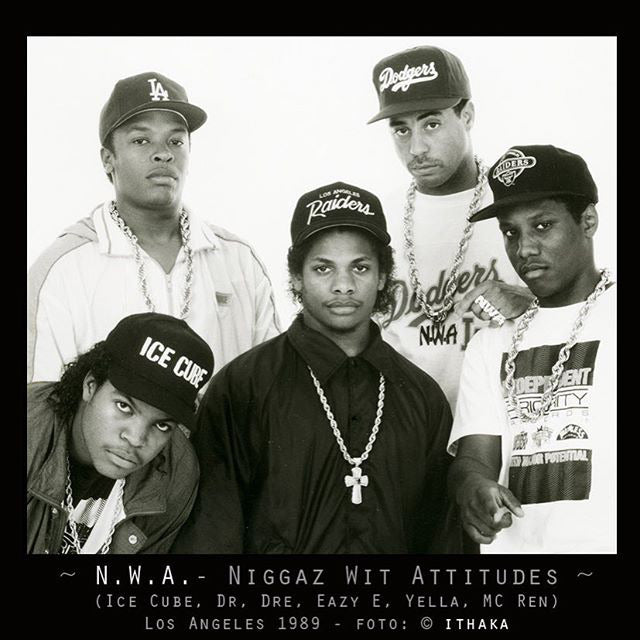
N.W.A Miracle Mile photographed by Ithaka Darin Pappas, Los Angeles, 1988.
BM: What is this photo known as? When and where was it taken?
IDP: This photo is known as The Miracle Mile. It was my first time photographing N.W.A and my first time shooting for Priority Records. It was intended to be the shoot for the cover of Eazy-E’s single “We Want Eazy". We were also trying to get publicity photos of N.W.A, as a group, which I didn’t get a whole lot of that day. We were also doing some publicity photos for Big Lady and she came by the shoot also.
BM: As in Big Lady K?
IDP: Yeah. She’s a rapper, half-Guatemalan, half-black from Riverside. She was fifteen at the time. An amazing talent.
There was no directing anybody. They come self-contained. You can pare down the shoot to a point, but everybody's individual personality is so strong, they're not very moldable.
BM: How did you land the gig? How did you connect with Priority?
IDP: It was completely by coincidence. I was already shooting stuff in the entertainment world, mostly young, teeny bopper stuff. I was looking for something edgier. One day I was skateboarding down my street, in an area known as the Miracle Mile, and a neighbor of mine pulls up in the driveway next to mine with a ton of groceries, and I asked if she needed some help. It turned out to be one of the Marketing Directors at Priority. She invited me to go show my book to the Art Director over there. So the next week I went in to show my book to the director, Elaine Friedman, and it worked out.
BM: That’s so random.
IDP: Yeah - and I was totally an N.W.A fan. Gangsta Gangsta was blowing up K-Day which was the main radio station at the time. I mean, I was really listening to this stuff a lot. Then suddenly these guys (N.W.A) were in my living room a couple weeks later. It was pretty cool.
BM: What year was this?
IDP: This was November of 1988, I think it was November 11th. It was around the near simultaneous release of Straight Outta Comptonand Eazy’s first album (Eazy-Duz-It), they came out almost the same time. It was like a grand slam, it was pretty crazy, they were everywhere!
Eazy-E, Big Lady K and N.W.A "Miracle Mile" Contact Sheet, courtesy of Ithaka Darin Pappas.
BM: Yeah, they were released a month apart I believe.
IDP: Yeah, I just remember Eazy and everybody rolling up to my place, which was in a really quiet semi-elderly Jewish neighborhood. They roll up in a GMC Safari, and they were just blasting the music! The neighbors were like “what’s going on?” It was great because I couldn’t stand my landlord at the time.
BM: Ha! No one’s going to mess with you in that scenario.
DP: Yeah, yeah. It was fun.
BM: Where on the N.W.A timeline did the Miracle Mile shoot take place? Were they mostly an L.A. thing at this point? Or was it bigger than that?
IDP: Well, I was only in L.A. so I don’t know. But in L.A. they were absolute underground legend status already. I don’t know how much mainstream people really knew about them, but in my world they were already household names after just six or seven months. [Ithaka chooses his words carefully] It was just such a raw…I think the thing that set this project apart…people that live in the suburbs were really aware of…I heard Cube say like a hundred times that N.W.A were street reporters, and nothing could be more accurate. At that time, all the violence happening was really behind the curtain. N.W.A brought us this slice of another reality, their reality, and it was really eye opening for a lot of people, myself included.
BM: Yeah, me too. So explain how the shoot went down. Did they hand over the reigns to you as the director? Did they take your direction?
IDP: There was no directing anybody. They come self-contained. You can pare down the shoot to a point, but everybody’s individual personality is so strong, they’re not very moldable. It was their time, it was their world. I was more a fly on the wall, trying to capture what they were all about. I was trying to record who they were.
BM: So this iconic image of gangsta rap's founding fathers was shot in your apartment?
IDP: Yeah, at 65** 1/2 Orange Street, L.A., Wilshire and San Vincente. Near the Museum Row area. They just came over. One thing I had noticed, even at this early point, was that there weren’t a lot of clean shots of them together. They were either riding, in the street, on the move, in sunglasses. It was hard to see what they looked like. For this shoot, I was just trying to show their faces. Like I was shooting for a fashion magazine. It was shot in my apartment with a couple of studio strobe heads. I had rented a Hasselblad camera, a high end camera. These were smaller budget shoots, the entire budget for that day was maybe five hundred dollars and that was to include film and everything. I spent way more than that because I wanted to do a good job. These were people whose music I loved and people who I admired. I didn’t know if I was ever going to shoot them again. I wanted to do a kick-ass job first time around.
BM: So you sensed that this could be a game changer for your career?
IDP: Yeah, I mean I had no idea they were going to blow up to become, you know, millennial figures. I had no idea it was going to go that large, but I knew this was something special.
BM: So what where they like? Describe their individual vibes.
DP: They were definitely tough guys, but also very funny, especially amongst themselves. Super funny cats.
BM: Yeah, I hung out with Eazy a couple times and he was fucking funny! I don’t think people realize how huge a role humour played in his personality.
IDP: Yeah, Eazy had an incredible sense of humor. He had absolute star quality. And he was also extremely easy to photograph. Out of the entire group he was the easiest. I mean he was so stylized, and he was just easy to work with. I found Dre to be pretty shy, photographically. Eazy was a clown, a funny guy. Ren was really tough. Yella was really nice. Cube was serious and determined, his intelligence absolutely permeated, really obvious, I could tell how high the guys IQ was after just a three minute conversation. Then I think we ended getting a bunch of nachos and drank old English. It got loud, it was fun.
BM: What was your relationship like with the guys at the start?
DP: (Laughing) No one really remembered my name.They just called me “the camera man”.
BM: I guess it’s obvious why.
DP: Well, we were shooting and the music was on, it was really loud. I was kind of standing on a stool, dancing to the music a bit, and Ren kinda pointed at me and smiled and said “check out the cameraman”. From then on i was “the cameraman”. I don’t think anybody called me anything but that from then on.
BM: How many sessions did you shoot with N.W.A? Over what period of time?
DP: Well beginning in ’88 and ’89’, ’90...and I shot Ice Cube I think in ’91. So I would say three years. Photographing them every two months. I would say it was a about three years. I think eighteen to twenty shoots total.
BM: Wow. So you had this access to them from the very start, through their break-up, and afterwards?
DP: Yeah and that was interesting too, because you know, arriving that first day, there was probably some live shows, nobody was really getting paid yet. Then two months later, people are driving nice cars. It was interesting to see it from a distance. I didn’t consider myself a friend, we didn’t really hang out, other than the Malibu “Wild and Wet party” but I would see them periodically and they were really getting famous so i would see, not really a difference in behaviour, but the accessories got a lot nicer!
BM: No doubt! So over the period that you shot them they were going through a lot of internal conflict. Were they still together the last time you shot them?
IDP: No, the last time I worked with N.W.A as a group Cube had already split. I worked with Cube a few times on his own projects, for video shoots and UK music magazines. That was as far as I got, I didn’t see Dre leave the group. I had moved back to Portugal by that time.
BM: Did you shoot Dre solo as well?
IDP: Not really. I mean I shot him by himself as a member of N.W.A. I would always pull people aside for little shoots. I did that with Dre. It was very improvisational. The one record cover that I shot, the only time we ever really had a layout, was for the We Want Eazy 12” cover. Everything else was “go out with the guys, get what you get". One of those images, a bleacher shot in McArthur Park, ended up as the cover for the Express Yourself (single) and Straight Outta Compton maxi-single cover. Mostly I would just try to pull people aside and get a few shots. In a way it kind of dictated my whole style of photography from then on, because I was so limited on time with everybody that it made me work faster and try to come up with things on the fly that professionally looked like studio set-ups but with natural light and trying to keep a wall, you know, so I’m kind of thankful for that experience. It was like guerrilla shooting.
BM: What equipment were you shooting on over those eighteen shoots? Was it one main camera?
IDP: I shot the Miracle Mile image on medium format Hasselblad. Most of the other shoots were on Nikon 250 FE, you know just a standard camera. It was photojournalism. I was just trying to get portraits. But that first shoot (Miracle Mile) I shot that on medium format ultra high quality. It was a camera I used for my actor shoots, I was already familiar using it in the studio so that’s what I brought to that shoot. I rented all the gear and we shot it in my living room.
BM: You also shot a series of photos with Eazy-E in Venice, skateboarding, which have become quite iconic. Can you tell me about those?
END PART ONE.
Source: https://blazedmade.com/blogs/news/interview-ithaka-darin-pappas
Links:
https://www.discogs.com/artist/468212-ITHAKA
https://www.youtube.com/channel/UCIZXy50yj_t9UuHqeOQhpGQ
http://planetithaka.blogspot.com/
https://genius.com/artists/Ithaka
https://en.wikipedia.org/wiki/Ithaka_Darin_Pappas
http://ithakaofficial.com/
https://www.facebook.com/IthakaBlue/
https://itunes.apple.com/us/artist/ithaka/69363540
https://store.cdbaby.com/artist/Ithaka2
https://www.instagram.com/_ithaka_/?hl=en
https://www.imdb.com/name/nm5225987/
https://thehundreds.com/blogs/content/ithaka-interview
https://pt.wikipedia.org/wiki/Ithaka
http://upmagazine-tap.com/en/pt_artigos/ithaka-2/



 At this point, many are familiar with the tale of Dr. Dre, Ice Cube, Eazy-E, DJ Yella, and MC Ren as NWA. The film Straight Outta Compton was a huge success and brought a lot of positive attention to the Hip Hop genre. The film gave people who haven’t invested time in Hip Hop a chance to learn about a different perspective in American History. Still, there is a lot that went into the certified platinum song from NWA’s most famous album that is easy to overlook just relying upon the movie.


