ASAHI EVENING NEWS, SATURDAY, SEPTEMBER 26, 1992
Fine Arts
City Life: Greed, Hunger
and Loss
By M. Jordan
Special to the Asahi Evening
News
The work now being shown at Galerie YMA in Tokyo, is
that of photographer/sculptor, Ithaka.
Although these two mediums seem at first glance to be separate entities,
these photos show that the two seem to go hand in hand. The photographs are a journey into the
mysteries of emotions. When
looking at them you cannot help but get caught up into the feelings they
conjure; happiness, remorsefulness, confusion unknowingness, mournfulness.
Ithaka enables the viewer to take a look into the world
(perhaps his own hermetic world) of bottled up emotions. His work is truly personal, his subjects
are close friends of his, yet one doesn't feel left out when viewing them.
Ithaka began assisting photographers at a very young age and
shortly thereafter went out on his own.
He has shot photographs for nearly every fashion magazine including, Vogue,
Elle and Glamour, and has also shot the record covers for many bands. The problem for Ithaka was that working
specific photograph jobs compromised him from the start. He began doing sculptures as a way to
take a break from the rigors of the job.
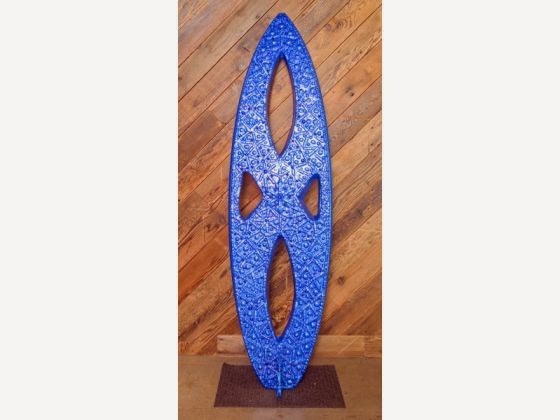
The sculptures used in the photos are cut and
restructured surfboards. All have
taken on a new form as well as a new life, displaying the forms of the human
body (usually female) as well as Ithaka's own creations. Before restrictions had been placed on
him as to how he could shoot his photos; he had been forced to take a back
seat. Now what he was yearning for
was to create his own type of photographs. He son began to fuse the two mediums, hence coining his own
term "sculptography."
Although Ithaka (Ithaka darin Pappas) was born and raised in Los Angeles,
the city proved to have too strong of an impact on his work. Los Angeles was too overbearing; and he
no longer wanted to struggle against the Los Angeles mindset that declares its
self to be the center of the globe.
This Los Angeles mindset is perfectly encapsulated in his sculptures
shown in this exhibit, entitled "Greed, Hunger, Loss," all
representing aspects typical of any metropolis.
His photos also show the lost feelings that are hard
to recover when living in a big city, yet they always remind us of why this
loss occurs. Lying peacefully
stretched out in the sand we are mesmerized by the serenity of "Joni by
the Sea," yet down below the rocky cliff reality sets in showing what the
city is all about--we see a Mercedes and a Lamborghini on the highway
below. Our illusion is shattered
and we are immediately pulled back into the present.
Ithaka 's search for eternal well being has led him to
Lisbon, Portugal where he is now based.
Portugal offers him a new outlook on life,. According to Ithaka, "life here is more simple, when
you're in a place like this -- life is about you and the people around you, not
the world at large." One has
to wonder where this new exploration will now take him, or us.
___________________________________________________________________________________
Works by Ithaka at Galerie YMA
(03-3562-0007
on Suzurandori in Ginza near Ginza subway station through Oct.7.
The
gallery is open from 11 a.m. to 7 p.m.
______________________________________________________________________________


 However, photographing in the light of day, sometimes in the middle of public squares and parks filled with thousands of people, did not prove to be an easy task.
Japanese people were quite shy when asked to show their navels in public to a stranger, further complicated by the fact that the photographer was a Gaijin (foreigner).
However, photographing in the light of day, sometimes in the middle of public squares and parks filled with thousands of people, did not prove to be an easy task.
Japanese people were quite shy when asked to show their navels in public to a stranger, further complicated by the fact that the photographer was a Gaijin (foreigner).  For this reason some sessions were held in the subjects’ homes or offices after first meeting them in public.
Regardless, because of the high rejection rate
(10-20 refusals for every one acceptance), sometimes it would take an entire day just to complete the belly-button portrait of only one or two subjects.
In addition to the Japanese majority of navels photographed, a percentage of outsiders were also included.
These individuals were from Brazil, China, Denmark, England, Germany, Malaysia, Pakistan, Russia, South Africa, South Korea, Spain, Sweden and the United States.
Subject ages ranged from three to ninety-six.
In addition to the Japanese majority of navels, a percentage of outsiders were also included. People from Brasil, China, Denmark, England, Germany, Malaysia, Pakistan, Russia, South Africa, South Korea, Sweden and the United States.
Says Ithaka,
“I didn’t photograph tourists for the project, but only actual residents of Tokyo.The foreigners who participated, mostly in their 20s-40s, were all living full-time in Tokyo and held a diverse spectrum of jobs from dishwasher to scientist.
Among the Japanese subjects - I photographed the navels of children as young as three (as well as those of their parents) and elderly people too, one in his late 90's.
The end result of UMBILICUS wasn’t only a study of human anatomy, but in actuality, concluded in becoming an anthropological observation of Tokyo’s population in 1992."
For this reason some sessions were held in the subjects’ homes or offices after first meeting them in public.
Regardless, because of the high rejection rate
(10-20 refusals for every one acceptance), sometimes it would take an entire day just to complete the belly-button portrait of only one or two subjects.
In addition to the Japanese majority of navels photographed, a percentage of outsiders were also included.
These individuals were from Brazil, China, Denmark, England, Germany, Malaysia, Pakistan, Russia, South Africa, South Korea, Spain, Sweden and the United States.
Subject ages ranged from three to ninety-six.
In addition to the Japanese majority of navels, a percentage of outsiders were also included. People from Brasil, China, Denmark, England, Germany, Malaysia, Pakistan, Russia, South Africa, South Korea, Sweden and the United States.
Says Ithaka,
“I didn’t photograph tourists for the project, but only actual residents of Tokyo.The foreigners who participated, mostly in their 20s-40s, were all living full-time in Tokyo and held a diverse spectrum of jobs from dishwasher to scientist.
Among the Japanese subjects - I photographed the navels of children as young as three (as well as those of their parents) and elderly people too, one in his late 90's.
The end result of UMBILICUS wasn’t only a study of human anatomy, but in actuality, concluded in becoming an anthropological observation of Tokyo’s population in 1992." UMBILICUS was published for the first time in January 1993 in the Japanese edition of the world-renowned fine art photography quarterly called Déja-Vu (Issue #11), the same issue that photographic legends Inose Kou, Frederick Sommer and Nobuyoshi Araki appeared.
Other international magazine appearances of UMBILICUS soon followed.
In 1995, the rock group Flood (signed to the Portuguese label, União Lisboa) chose images from UMBILICUS to appear on the front and back cover of their debut album, Despertar.
UMBILICUS was published for the first time in January 1993 in the Japanese edition of the world-renowned fine art photography quarterly called Déja-Vu (Issue #11), the same issue that photographic legends Inose Kou, Frederick Sommer and Nobuyoshi Araki appeared.
Other international magazine appearances of UMBILICUS soon followed.
In 1995, the rock group Flood (signed to the Portuguese label, União Lisboa) chose images from UMBILICUS to appear on the front and back cover of their debut album, Despertar.


 [Contact High: Hip-Hop’s Iconic Photographs and Visual Culture]