Tuesday, September 4, 2018

BLAZEDMADE INTERVIEW VOL.001, PART ONE, ITHAKA DARIN PAPPAS (@_ITHAKA_) N.W.A PHOTOGRAPHER, 1988-91

BLAZEDMADE INTERVIEW VOL.001, PART ONE,
ITHAKA DARIN PAPPAS (@_ITHAKA_) N.W.A PHOTOGRAPHER, 1988-91

August 31, 2018
Welcome to The Blazedmade Interview. Here we bring you exclusive, intimate and engaging conversations with those who live at the intersection of hip-hop, fashion and culture. From artists and producers to choreographers and creative directors, we pull back the curtain on raps' icons and unsung heroes, past and present.
We’re thrilled to kick things off with Ithaka Darin Pappas, who in 1988, was annointed N.W.A's official photographer by the groups label/distributor Priority Records.
Blazedmade founder Daniel Cutler spoke with Ithaka at his home in L.A. where the photographer-artist-surfer revealed, for the first time, the story behind his iconic N.W.A "Miracle Mile” shot, an increasingly important image that Blazedmade is proud to feature in our first collection.
The two also discussed the day skateboarding went gangsta rap and how, inexplicably, most of the N.W.A photos that Ithaka shot from 1988-1991 have never actually been seen.
BM: Where are you from and where did you grow up? 
DP: I’m from southern California, lived between and LA and Orange Country most of my life. 
BM: When did you start getting in to photography? 
DP: I’ve always been in to it. My dad was a devout hobbyist, I’ve been shooting photos since I was five years old. I sold my first picture when I was 17 years old. 
BM: Who for? 
DP:  Independent - a skateboard brand. In 1984 I think.
BM: Sure I know Independent. Did you skate?  
DP: I’m a surfer. I was really just photographing skateboarders. I skate but I was much more behind the camera in that activity, whereas in surfing I was not behind the camera at all. 
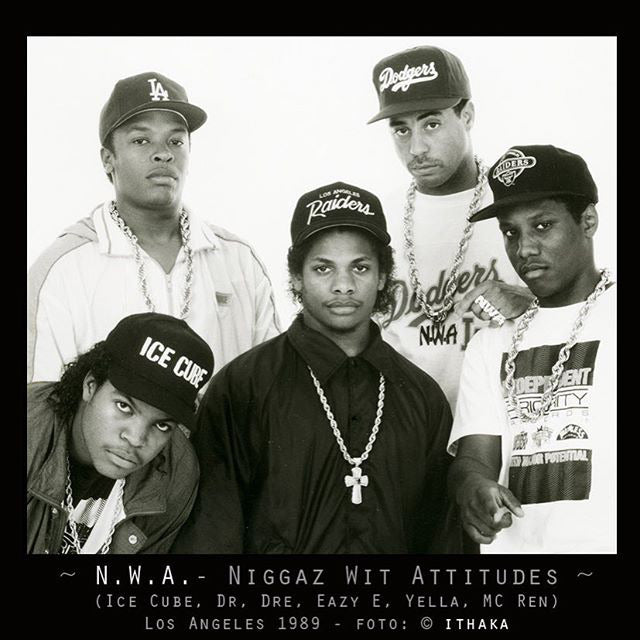
N.W.A Miracle Mile photographed by Darin Ithaka Pappas, Los Angeles, 1988.

BM: What is this photo known as? When and where was it taken? 
DP: This photo is known as The Miracle Mile. It was my first time photographing N.W.A and my first time shooting for Priority Records. It was intended to be the shoot for the cover of Eazy-E’s single “We Want Eazy". We were also trying to get publicity photos of N.W.A, as a group, which I didn’t get a whole lot of that day. We were also doing some publicity photos for Big Lady and she came by the shoot also. 
BM: As in Big Lady K? 
DP: Yeah. She’s a rapper, half-Guatemalan, half-black from Riverside. She was fifteen at the time. An amazing talent. 
There was no directing anybody. They come self-contained. You can pare down the shoot to a point, but everybody's individual personality is so strong, they're not very moldable. 
BM: How did you land the gig? How did you connect with Priority? 
DP: It was completely by coincidence. I was already shooting stuff in the entertainment world, mostly young, teeny bopper stuff. I was looking for something edgier. One day I was skateboarding down my street, in an area known as the Miracle Mile, and a neighbor of mine pulls up in the driveway next to mine with a ton of groceries, and I asked if she needed some help. It turned out to be one of the Marketing Directors at Priority. She invited me to go show my book to the Art Director over there. So the next week I went in to show my book to the director, Elaine Friedman, and it worked out. 
BM: That’s so random. 
DP: Yeah - and I was totally an N.W.A fan. Gangsta Gangsta was blowing up K-Day which was the main radio station at the time. I mean, I was really listening to this stuff a lot. Then suddenly these guys (N.W.A) were in my living room a couple weeks later. It was pretty cool. 
BM: What year was this? 
DP: This was November of 1988, I think it was November 11th. It was around the near simultaneous release of Straight Outta Comptonand Eazy’s first album (Eazy-Duz-It), they came out almost the same time. It was like a grand slam, it was pretty crazy, they were everywhere!

Eazy-E, Big Lady K and N.W.A "Miracle Mile" Contact Sheet, courtesy of Darin Ithaka Pappas.

BM:  Yeah, they were released a month apart I believe.
DP: Yeah, I just remember Eazy and everybody rolling up to my place, which was in a really quiet semi-elderly Jewish neighborhood. They roll up in a GMC Safari, and they were just blasting the music! The neighbors were like “what’s going on?” It was great because I couldn’t stand my landlord at the time. 
BM: Ha! No one’s going to mess with you in that scenario.  
DP:  Yeah, yeah. It was fun.
BM: Where on the N.W.A timeline did the Miracle Mile shoot take place? Were they mostly an L.A. thing at this point? Or was it bigger than that? 
DP: Well, I was only in L.A. so I don’t know. But in L.A. they were absolute underground legend status already. I don’t know how much mainstream people really knew about them, but in my world they were already household names after just six or seven months. [Ithaka chooses his words carefully] It was just such a raw…I think the thing that set this project apart…people that live in the suburbs were really aware of…I heard Cube say like a hundred times that N.W.A were street reporters, and nothing could be more accurate. At that time, all the violence happening was really behind the curtain. N.W.A brought us this slice of another reality, their reality, and it was really eye opening for a lot of people, myself included. 
BM: Yeah, me too. So explain how the shoot went down. Did they hand over the reigns to you as the director? Did they take your direction?
DP: There was no directing anybody. They come self-contained. You can pare down the shoot to a point, but everybody’s individual personality is so strong, they’re not very moldable. It was their time, it was their world. I was more a fly on the wall, trying to capture what they were all about. I was trying to record who they were. 
BM: So this iconic image of gangsta rap's founding fathers was shot in your apartment? 
DP: Yeah, at 65** 1/2 Orange Street, L.A., Wilshire and San Vincente. Near the Museum Row area. They just came over. One thing I had noticed, even at this early point, was that there weren’t a lot of clean shots of them together. They were either riding, in the street, on the move, in sunglasses. It was hard to see what they looked like. For this shoot, I was just trying to show their faces. Like I was shooting for a fashion magazine. It was shot in my apartment with a couple of studio strobe heads. I had rented a Hasselblad camera, a high end camera. These were smaller budget shoots, the entire budget for that day was maybe five hundred dollars and that was to include film and everything. I spent way more than that because I wanted to do a good job. These were people whose music I loved and people who I admired. I didn’t know if I was ever going to shoot them again. I wanted to do a kick-ass job first time around. 
BM: So you sensed that this could be a game changer for your career?  
DP: Yeah, I mean I had no idea they were going to blow up to become, you know, millennial figures. I had no idea it was going to go that large, but I knew this was something special. 
BM: So what where they like? Describe their individual vibes.
DP: They were definitely tough guys, but also very funny, especially amongst themselves. Super funny cats. 
BM: Yeah, I hung out with Eazy a couple times and he was fucking funny! I don’t think people realize how huge a role humour played in his personality.
DP: Yeah, Eazy had an incredible sense of humour. He had absolute star quality. And he was also extremely easy to photograph. Out of the entire group he was the easiest. I mean he was so stylized, and he was just easy to work with. I found Dre to be pretty shy, photographically. Eazy was a clown, a funny guy. Ren was really tough. Yella was really nice. Cube was serious and determined, his intelligence absolutely permeated, really obvious, I could tell how high the guys IQ was after just a three minute conversation. Then I think we ended getting a bunch of nachos and drank old English. It got loud, it was fun. 
BM: What was your relationship like with the guys at the start? 
DP: (Laughing) No one really remembered my name.They just called me “the camera man”. 
BM: I guess it’s obvious why.
DP: Well, we were shooting and the music was on, it was really loud. I was kind of standing on a stool, dancing to the music a bit, and Ren kinda pointed at me and smiled and said “check out the cameraman”. From then on i was “the cameraman”. I don’t think anybody called me anything but that from then on.
BM: How many sessions did you shoot with N.W.A? Over what period of time? 
DP: Well beginning in ’88 and ’89’, ’90...and I shot Ice Cube I think in ’91. So I would say three years. Photographing them every two months. I would say it was a about three years. I think eighteen to twenty shoots total.
BM: Wow. So you had this access to them from the very start, through their break-up, and afterwards? 
DP: Yeah and that was interesting too, because you know, arriving that first day, there was probably some live shows, nobody was really getting paid yet. Then two months later, people are driving nice cars. It was interesting to see it from a distance. I didn’t consider myself a friend, we didn’t really hang out, other than the Malibu “Wild and Wet party” but I would see them periodically and they were really getting famous so i would see, not really a difference in behaviour, but the accessories got a lot nicer! 
BM: No doubt! So over the period that you shot them they were going through a lot of internal conflict. Were they still together the last time you shot them? 
DP: No, the last time I worked with N.W.A as a group Cube had already split. I worked with Cube a few times on his own projects, for video shoots and UK music magazines. That was as far as I got, I didn’t see Dre leave the group. I had moved back to Portugal by that time. 
BM: Did you shoot Dre solo as well? 
DP: Not really. I mean I shot him by himself as a member of N.W.A. I would always pull people aside for little shoots. I did that with Dre. It was very improvisational. The one record cover that I shot, the only time we ever really had a layout, was for the We Want Eazy 12” cover. Everything else was “go out with the guys, get what you get".  One of those images, a bleacher shot in McArthur Park, ended up as the cover for the Express Yourself (single) and Straight Outta Compton maxi-single cover. Mostly I would just try to pull people aside and get a few shots. In a way it kind of dictated my whole style of photography from then on, because I was so limited on time with everybody that it made me work faster and try to come up with things on the fly that professionally looked like studio set-ups but with natural light and trying to keep a wall, you know, so I’m kind of thankful for that experience. It was like guerrilla shooting. 
BM: What equipment were you shooting on over those eighteen shoots? Was it one main camera? 
DP: I shot the Miracle Mile image on medium format Hasselblad. Most of the other shoots were on Nikon 250 FE, you know just a standard camera. It was photojournalism. I was just trying to get portraits. But that first shoot (Miracle Mile) I shot that on medium format ultra high quality. It was a camera I used for my actor shoots, I was already familiar using it in the studio so that’s what I brought to that shoot. I rented all the gear and we shot it in my living room. 
BM: You also shot a series of photos with Eazy-E in Venice, skateboarding, which have become quite iconic. Can you tell me about those? 
END PART ONE. PART TWO COMING SOON.


BLAZEDMADE INTERVIEW VOL.001, PART ONE,<BR>ITHAKA DARIN PAPPAS (@_ithaka_) N.W.A PHOTOGRAPHER, 1988-91
Ithaka with his artworks.

Friday, August 10, 2018

Melo D & Ithaka (Dueto) "HIDDEN BY THE SEA" Cool Hipnoise ft. Ithaka (Live Antena 3, Portugal 1997)


HIDDEN BY THE SEA (Youtube above)

Cool Hipnoise feat. Ithaka (Live on Antena 3, Portugal 1997).
Vocals: Melo D and Ithaka.

Lyrics written by Ithaka Darin Pappas (with some improved lyrics by Melo D).

Music written and performed by: Cool HipNoise
https://www.discogs.com/Various-Ao-Vi... Also known as Eden By The Sea ________________________________________________________________


(Ithaka): Give that a test (Melo D): Darin, vamos rebentar a casa, let's bust it. (Ithaka): Let's bust it live. (Melo D): Let's make some noise brother. (Ithaka): All right (Melo D): Chama-se Eden By The Sea (Ithaka): Once while sleeping sad / with a dome full of confusion a bumble bee named Melo D gave me a new solution flew straight into my ear and said into my brain (Melo D): "Yo Korvorão what's up man?, let's do some damage man...I wanna take you to a place, take you down. (Ithaka): What do you mean? Where can we go? cuz as usual ... I'm flat broke ... (Melo D): Não digas, I wanna take you to a place I know, check it out. We go to a place called Eden by the sea where life is sweet and everyone is free where all is love ... and everyone is free so come on, meu irmão Korvorão you worn out ravenshark get yourself up ... up yourself from out of the dark sharpen up your fins ... shake out your wings a big smile is all you need to bring don't need no money don't need no style don't worry about a thing and you will go a long while can't get there by a boat can't get there by a plane except with the private plane, the private plane of your brain don't need no belief in Adam and Eve but belief in the garden that is your key you can do anything or you can do nothing there you will never feel cold (Melo D & Ithaka): so give me sweet life ... so give me sweet life ... (Melo D): where life is sweet and everyone is free where all is love ... and everyone is free and everyone is free (Melo D & Ithaka): so give me sweet life ...let me be free so give me sweet life ...let me be free (Ithaka): I said hey Melo D what are we waiting for? You already convinced me ... no need to say more so off we went on a piece of blue rug one whacked-out ravenshark ... and brother bee bug (Melo D): out to the space ... another galaxy destination known ... Eden By The Sea I call her a place ... but she is more like a lover sometimes like a sister ... sometimes like a mother she's accidental poetry and she goes by the name Eden By The Sea (Ithaka): and when I finally met her - almost took my life almost drowned me ... while I tried to take a ride but no I wasn't mad at her that's when I began to love her because a strong woman is good to find it was love at first fall with my heart and my mind up on a cliff inside of a cave or in the sea inside of a wave in the shade of a mango tree or hanging in the garden with Melo D Bee (Melo D & Ithaka): so give me sweet life let me be free so give me sweet life give me (Melo D): where life is sweet and everyone is free where all is love and everyone is free and everyone is free (Melo D & Ithaka): so give me sweet life let me be free so give me sweet life let me be free (Ithaka): but the alarm went off ... and my peace left my head my eyes struggled opened and there I was in my old bed all alone in my room ... no Eden in sight well how could I have lived so much in one night? My stomach began to hurt ... tears rained from my eyes been two hundred years since the ravenshark cried now all on my mind is "how am I gonna get back"? I know Eden exists I know she's fact so brother bee Melo D ... wherever you may be please take me back to Eden by The Sea, bro (Melo D & Ithaka): so give me sweet life let me be free so give me sweet life let me be free (Melo D): where life is sweet and everyone is free where all is love and everyone is free and everyone is free (Melo D & Ithaka): so give me sweet life let me be free so give me sweet life let me be free (Ithaka): at Eden by the sea where everybody's free (Melo D): Eden By The Sea Give me Eden By The Sea Give me Give me Give me sweet life Give me Give me Give me Give me Give me (Melo D & Ithaka): so give me sweet life let me be free so give me sweet life let me be free (Melo D): where life is sweet and everyone is free where all is love and everyone is free and everyone is free so give me sweet life let me be free so give me sweet life let me be free so give me sweet life let me be free so give me sweet life let me be free so give me sweet life let me be free so give me sweet life let me be free so give me sweet life let me be free so give me sweet life let me be free (Melo D): Darin Pappas
_______________________________________________
Links:
https://www.discogs.com/artist/468212-ITHAKA
https://www.youtube.com/channel/UCIZXy50yj_t9UuHqeOQhpGQ
http://planetithaka.blogspot.com/
https://genius.com/artists/Ithaka
https://en.wikipedia.org/wiki/Ithaka_Darin_Pappas
http://ithakaofficial.com/
https://www.facebook.com/IthakaBlue/
https://itunes.apple.com/us/artist/ithaka/69363540
https://store.cdbaby.com/artist/Ithaka2
https://www.instagram.com/_ithaka_/?hl=en
https://www.imdb.com/name/nm5225987/
https://thehundreds.com/blogs/content/ithaka-interview
https://pt.wikipedia.org/wiki/Ithaka
http://upmagazine-tap.com/en/pt_artigos/ithaka-2/

Monday, July 2, 2018

Contemporary Sculpture Work by, Ithaka


Artwork by Greek-Californian contemporary artist, Ithaka
_______________________________________________
Links:
https://www.discogs.com/artist/468212-ITHAKA
https://www.youtube.com/channel/UCIZXy50yj_t9UuHqeOQhpGQ
http://planetithaka.blogspot.com/
https://genius.com/artists/Ithaka
https://en.wikipedia.org/wiki/Ithaka_Darin_Pappas
http://ithakaofficial.com/
https://www.facebook.com/IthakaBlue/
https://itunes.apple.com/us/artist/ithaka/69363540
https://store.cdbaby.com/artist/Ithaka2
https://www.instagram.com/_ithaka_/?hl=en
https://www.imdb.com/name/nm5225987/
https://thehundreds.com/blogs/content/ithaka-interview
https://pt.wikipedia.org/wiki/Ithaka
http://upmagazine-tap.com/en/pt_artigos/ithaka-2/

Tuesday, June 19, 2018

DJ/Author Bill Brewster Plays AcidCamp - Los Angeles

________________________________________________________
Last Sunday (June 17th 2018) legendary UK music author and DJ Bill Brewster put on an incredible performance for a select few in Los Angeles courtesy of Acid Camp.

Saturday, June 2, 2018

Os maiores talentos portugueses dos anos 90 - Por Luis Maio (Público)


Ithaka Darin Pappas gravando So Get Up


Os Lit querem devolver o "showbiz", estilo "Rat Pack" de Sinatra, ao rock. E gostam de Cadillacs, Las Vegas e Elvis. Fazem bem. O PÚBLICO falou com A. Jay Popoff, vocalista desta banda californiana tão genuinamente americana.
Quisemos eleger os maiores artistas pop/rock/world portugueses dos anos 90. Não aqueles com uma carreira já antes estabelecida, que chegaram ou se mantiveram na ribalta nestes últimos dez anos, o que exclui à partida nomes como Madredeus e Dulce Pontes. Mas apenas os novos talentos, que gravaram pela primeira vez em longa-duração e marcaram a música portuguesa (ou, para ser mais rigoroso, produzida em Portugal) nesta década. "Marcar" aqui, tem de se reconhecer, é um pouco ambíguo e esta escolha é um compromisso entre a importância objectiva dos artistas e os nossos gostos pessoais. A conclusão a que chegámos é que há pelo menos dez nomes fundamentais dos nossos anos 90, o que já não é nada mau. Mas a impressão com que também ficámos, e deverá ficar como objecto de uma futura sistematização, é que esta década não foi genericamente tão produtiva quanto a precedente para a música portuguesa. Houve alguma necessidade da parte dos novos talentos de cortarem com a geração precedente, a dos GNR, Delfins, Trovante e Xutos, nomeadamente no sentido de questionar a necessidade de obedecer a um formato de canção pop/rock e de cantar em inglês. Mas essa ruptura não foi tão frutuosa ou ainda está em boa parte por cumprir. Na votação participaram Vítor Belanciano, Rui Catalão, Fernando Magalhães, Luís Maio, Tiago Luz Pedro e Pedro Ribeiro. O Prince português. Um cantor de intervenção para os anos 90. Um cínico manipulador dos media. Pedro Abrunhosa já foi chamado tudo isto, e a sua carreira inclui tudo isto.Abrunhosa é talvez a única estrela rock portuguesa actual cuja relevância transcende a música. Se o valor choque de "F" ou os seus protestos contra as portagens na Ponte 25 de Abril podem ser interpretados como manobras de "marketing", ninguém pode negar que Abrunhosa tem uma imagem forte e um discurso coerente e articulado. Credite-se Abrunhosa com o mérito de resistir à sobreexposição: houve uma altura em que o músico portuense era chamado a pronunciar-se sobre tudo, desde a compra do Coliseu pela IURD até aos resultados do Benfica. Pelo caminho, tornou-se actor no último filme de Manoel de Oliveira, "A Carta", prestes a estrear.Mas Abrunhosa soube resguardar-se num silêncio que aumenta a curiosidade para o seu álbum de 1999. Como irá ele adaptar-se a um Portugal governado por uma dialogante Nova Maioria e não por um rígido Cavaco? Que tipo de provocação nos reserva Abrunhosa para o final de uma década que ele marcou na música, na política e na moda? Qual é a sua marca de óculos escuros? Um país inteiro aguarda ansiosamente. P.R.Já não há desculpa para se afirmar que não existe uma verdadeira banda portuguesa de pop psicadélica. Ela existe e chama-se Três Tristes Tigres. Mas se esta vertente, se não inédita (quem se recorda, nos anos 70, dos Beatnicks, da "Cosmonicação"?), pelo menos muito pouco comum, da música popular produzida em Portugal, tem razão de existir, quando estamos prestes a entrar num novo milénio, tal deve-se ao "input" nos TTT de Alexandre Soares. Foi graças ao antigo guitarrista dos GNR que a banda do Porto renovou o seu stock de canções assentes no delírio sonoro e na qualidade dos textos escritos por Regina Guimarães. Com Alexandre Soares, os TTT entraram, sem medo, no comboio-fantasma da electrónica e dos sonhos com ligação directa ao sistema de PA. De "Partes Sensíveis", o disco de estreia, até ao mais recente, "Comum", passando por "Guia Espiritual", os TTT passaram de sonoplastas da palavra a arquitectos do inconsciente. Ana Deus, cantora dos TTT, faz a síntese do caminho que o presente abriu aos TTT: "É perturbador!". F.M."Bárbaros!" Era com este grito de susceptibilidade que o bardo Assurancetorix respondia aos insultos que o resto da tribo de irredutíveis gauleses lhe dirigia, quando se atrevia a cantar. Os Gaiteiros de Lisboa nunca foram propriamente insultados, mas, se o fossem, seria sempre por outras razões. Porque, antes deles, a música de raiz tradicional portuguesa descansava à sombra da bananeira, que é como quem diz, da papa toda feita nas décadas anteriores por José Afonso, dos que faziam das recolhas étnicas profissão de fé e do trabalho, sem dúvida louvável, mas sempre respeitador, da geração anterior de grupos da mesma área. Os Gaiteiros chegaram e deitaram tudo abaixo. Niilistas? Iconoclatas, talvez! Depois, sobre os escombros, edificaram um edifício novo tão ou mais deslumbrante que o antigo. Em apenas dois álbuns, "Invasões Bárbaras" e "Bocas do Inferno" (vencedor do Prémio José Afonso do ano passado), os Gaiteiros de Lisboa deram um rosto novo e de desafio à música popular portuguesa. Para muitos, o rosto de um demónio. Mas não é Lúcifer o anjo portador da luz? F.M."Ithaka", o poema do grego Konstantinos Kavafy de onde foi retirado o nome deste projecto transnacional, encabeçado pelo norte-americano de origem grega Ithaka Darin Pappas, é uma metáfora que fala da perseguição de um ideal e da conclusão de que o importante não é alcançá-lo, mas o caminho que se percorre até o alcançar. Foi com base nesta premissa que o Ithaka acrescentaram uma nova dimensão ao hip-hop português, menos interessada na urgência do realismo das palavras e dos rostos negros que as cantam e mais próxima daquilo que eles próprios rotularam de "fabula funk". Os álbuns "Flowers and the Color of Paint" e, sobretudo, "Stellafly", o mais poderoso e consistente registo nacional editado em 1997, são em ambos os casos exercícios de puro bom gosto que abrem a enciclopédia da música negra ao mesmo tempo que recusam o lugar fixo e imediato a que a sua apropriação em Portugal tantas vezes a confinou. Korvorowng, o "alter ego" do poeta, artista plástico e surfista Ithaka Darin Pappas - que também pode ser lido como Korvorão ou "Ravenshark" -, é isto: metade corvo e metade tubarão, porque tanto os peixes como as aves não têm de reconhecer fronteiras. Antes as deixam abertas à força da vontade e à sede do desejo, que apenas prometem esgotar-se com o fim do tempo e da errância no tempo a que o tempo nos votou. T.L.P.Passou recentemente no Teatro Maria Matos um "one-travesti show" intitulado Maria Bakker (lê-se báquer, e não beiquer). Nessa desconstrução sentimental mas também sarcástica das grandes divas do cinema e da canção, era impossível não encontrar um paralelismo com a música dos Belle Chase Hotel, cujo esplendor reside não em puxar o lustro ao charme decadente do crepúsculo dos deuses, mas em lhe admirar a poeira, a ferrugem que entretanto corroeu o mundo do espectáculo. Assim sendo, toda a mitologia deste século transformou-se finalmente na "ópera de três vinténs" de Weill-Brecht. Tal como Maria Bakker, ou como as canções de cabaré de Kurt Weill, o inglês de JP Simões não é perfeito, assume-se como um travesti, mas onde ainda se reconhecem traços de uma nobreza encardida, pela forma anacrónica com que se apropriaram de um legado artístico de que nunca foram herdeiros legais. Os Belle Chase não descendem de uma linhagem como os Divine Comedy, antes roubaram o ouro dos tolos. São estas as riquezas dos pobres, usar as jóias que os ricos deitaram fora. Não deixa assim de ser significativo que no videoclip de "Fossa Nova", JP se tenha travestido. Maria Bakker? R.C.O que teria acontecido se o sucesso mundial "So Get up" dos Underground Sound of Lisbon tivesse tido sequência? A resposta ficará para sempre guardada na sepultura das incertezas, mas não custa imaginar que a atenção hoje em dia dispensada a outros centros da música de dança que escapam ao domínio anglo-saxónico, como Paris, podia muito bem ter ocorrido em Lisboa há cinco anos. É verdade que o sucesso mundial que a dupla Tó Pereira (DJ Vibe) e Rui Silva (Doctor J) almejou com "So Get up" - com a preciosa ajuda na voz e letra de Ithaka Darin Pappas - teve consequências de ordem prática, como o facto de Portugal ter visto nascer uma nova cultura do entretenimento em que "disc-jockeys", produtores de música ou produtoras de festas se afirmaram. Mas, fica a sensação de que aquilo que foi conseguido ao nível do desenvolvimento de uma nova cultura hedonista, nunca teve a devida repercussão ao nível discográfico. A esperança não morreu (o regresso dos U.S.L. no ano passado e a afirmação de diferentes nomes como Alex FX, Paul Jays, Love Rec., Arkham Hi-Fi, N+C, Mr. Spock ou Morrice provam-no), mas, olhando para trás, não restam dúvidas de que "So Get up", para além de todas as portas que abriu, constituiu também uma oportunidade perdida. V.B.Tendo sido o primeiro projecto a assinar um álbum de hip-hop em Portugal, os DaWeasel cedo deram mostras de querer demarcar-se da militância retórica que caracterizou a segunda geração de africanos em Portugal, assente numa correcção política esteriotipada e num sentido de colectivismo por regra simplista. A sua produção, espelhada nos álbuns "More than 30 Motherf***s", "Dou-lhe com a Alma" e "3º Capítulo", orientou-se antes pela via de discurso vincadamente personalizado e elaboradamente pessimista, que rapidamente deixou para trás a idade da inocência que definiu a geração fundadora do rap em Portugal. Mais: no momento em que o público se habituava ainda ao rap português, já os Da Weasel lhe subvertiam as regras, ao mesmo tempo que patenteavam um domínio musical e uma qualidade de produção que nada ficava a dever aos seus homólogos estrangeiros. Recusaram a colagem a referências mais ou menos bem dissimuladas de lugares-comuns e ganharam um líder, Pacman, que é hoje uma referência incontornável no universo do hip-hop nacional. Preparem-se. A doninha está prestes a voltar com um novo álbum. T.L.P.A conquista recente do Prémio José Afonso, pelo álbum "Taco a Taco", não fez mais do que reconhecer a importância da obra de Amélia Muge enquanto herdeira daquele que foi, em Portugal, o arauto da insatisfação, do empenhamento ideológico e da inovação estética: José Afonso. Como o autor de "Cantigas do Maio", Amélia Muge não dispensa a interrogação dos propósitos e motivos que conduzem à criação musical, o que significa que o disco, mais do que produto de uma indústria, deverá ser o espelho da história - do criador e do tempo em que vive. Mas a esta necessidade de conceptualização correspondeu desde o álbum de estreia, "Múgicas" e, a seguir, em "Todos os Dias", essa outra necessidade de arriscar e pôr em causa o que se fez e pensou antes. Amélia Muge, para além do prodígio de força e expressividade que é a sua voz, possui esse outro talento, bastante mais raro: o fogo de uma alma em eterna demanda. Com ela a música tradicional e o legado de autores como José Afonso ou José Mário Branco ganhou verdadeiramente o direito de entrar no 5º Império. F.M.Quando apareceram no final dos anos 80, princípio dos 90, os Repórter Estrábico constituíram uma autêntica lufada de ar fresco na cena musical portuguesa. Nos álbuns "Uno Dos" (1991), "1Bigo" (1994), "Disco de Prata" (1996), no recente "Mouse Music" (1999) ou nos diversos discos de formato reduzido como "John Wayne" (1992) e "Repórter Estrábico vs Alex FX" (1995), o grupo do Porto definiu um território próprio, onde os materiais da cultura pop (a música, mas também os filmes, a BD ou a publicidade) são reavaliados segundo uma atitude distanciada, crítica e irónica. Ao meio musical português, sisudo e algo conservador, os Repórter Estrábico acrescentaram uma atitude humorada - onde o absurdo dos Monthy Phyton anda a par da provocação "chic" dos artistas pop -, mas é necessário não esquecer a música. Excelente música por sinal. As saídas do "performer" António Olaio e do compositor e guitarrista José Ferrão foram sentidas (principalmente a deste último) no seio do grupo, mas nem por isso as arquitecturas sonoras que devem algo aos Can, deixaram de assimilar as diversas conjunturas da música pop, sem que o grupo tenha perdido a sua identidade ao longo dos anos. V.B.Qual é a banda portuguesa mais bem sucedida no estrangeiro - Madredeus ou Moonspell? A resposta tem uma importância relativa, mas enquanto se debate a exportabilidade dos Silence 4 ou dos The Gift para mercados internacionais, é estranho que os Moonspell sejam mencionados apenas como uma curiosidade bizarra e algo inexplicável.Esta relativa indiferença surpreende. Num país geralmente obcecado com os seus êxitos "lá fora", que se orgulha patrioticamente dos seus Figos, Rui Costas, Madredeus ou Joaquim de Almeidas, os Moonspell continuam algo ignorados, um meio-segredo (ir)religiosamente acarinhado por um aguerrido e empenhado núcleo de convertidos.A explicação pode ter a ver com o estilo de música dos Moonspell - muito do grande público português não tem grande estima pelo death metal gótico. A banda de Fernando Ribeiro não poderá nunca ser uma embaixadora de Portugal como o são os Madredeus.O que é certo é que, no seu nicho de mercado, os Moonspell são importantes na Europa: os álbuns "Wolfheart", "Irreligious" e "Sin/Pecado" foram razoáveis êxitos em sítios tão díspares como a Polónia, a França ou a Itália. Talvez tenha chegado a altura de lhes dar mais atenção. P.R.
(Público)  10 de Setembro de 1999

https://www.publico.pt/1999/09/10/jornal/os-maiores-talentos-portugueses-dos-anos-90-123587

Trying to remember Ithaka (from blog: Stories from A Closet of Errors)


Trying to remember Ithaka


M. bought this dress Monday morning (my time zone) and the rest of my day was spent trying to remember what seemed to have been long forgotten.
I can’t remember the last time I wore this dress, but I am sure I wore it during a chilly evening in the summer of 1997 at a concert in Montemor‘s castle. I remember who was with me and the theory that “villages with medieval castles are always cold” but I could not remember who was playing.
Trying to dig up something that you have forgotten to remember from the pre-internet era is not always easy. I tried to google what I did remember. The same artist was also a photographer who, probably in the same year, had an installation called “I could write a book” at Galeria Zé dos Bois in Lisbon.  Inspired by the famous jazz standard, specifically by Dinah Washington’s rendition of it (1955), the installation featured an unmade bed, photos and diary entries and little notes from the time the author lived, in Tokyo because if someone had asked him, he could have written a book.
If they asked me, I could write a book
About the way you walk, and whisper, and look
I could write a preface
On how we met
So the world would never forget
But I did forget and, as the day progressed I felt more and more irritated at not being able to recall the name. Probably C. went with me to Lisbon so I decided to send an email explaining my quasi existential doubt of the day. He thought it was absurd and called me. He had no recollection whatsoever of such installation he most probably did go but couldn’t remember. We also saw this same guy at Labirintho, I said. Remember that? We went with another friend who got drunk and almost in trouble. Remember that? I even remember where we had parked the car and that we drove away and Cake’s Fashion Nugget was playing. He could not remember anything at all. It seems like we have done really interesting stuff together in the 90s, though.
By 8 pm I could recall some Greek connection and my Google search was “Californian musician, Greek ancestry, living in Lisbon in the 90s”. There it was an article about “the greatest Portuguese talents of the 90s”, about the great “unknown”, groundbreaking talent of Portuguese Pop/Rock and the growing popularity of Dance and Hip-Hop scenes. Finally Darin Pappas, aka Ithaka Darin Pappas aka Korvowrong and the album “Stellafly”, the most powerful and consistent national registry edited in 1997. That might help explain why I seemed to have travelled across the country to hear him even if now it doesn’t really make much sense.
But then again, C.P. Cavafy’s IthaKa is the conclusion that it’s never about getting there but always about the search, as long as you understand what the Ithakas mean.
As you set out for Ithaka
hope the voyage is a long one,
full of adventure, full of discovery.
Laistrygonians and Cyclops,
angry Poseidon—don’t be afraid of them:
you’ll never find things like that on your way
as long as you keep your thoughts raised high,
as long as a rare excitement
stirs your spirit and your body.
Laistrygonians and Cyclops,
wild Poseidon—you won’t encounter them
unless you bring them along inside your soul,
unless your soul sets them up in front of you.

Hope the voyage is a long one.
May there be many a summer morning when,
with what pleasure, what joy,
you come into harbors seen for the first time;
may you stop at Phoenician trading stations
to buy fine things,
mother of pearl and coral, amber and ebony,
sensual perfume of every kind—
as many sensual perfumes as you can;
and may you visit many Egyptian cities
to gather stores of knowledge from their scholars.

Keep Ithaka always in your mind.
Arriving there is what you are destined for.
But do not hurry the journey at all.
Better if it lasts for years,
so you are old by the time you reach the island,
wealthy with all you have gained on the way,
not expecting Ithaka to make you rich.

Ithaka gave you the marvelous journey.
Without her you would not have set out.
She has nothing left to give you now.

And if you find her poor, Ithaka won’t have fooled you.
Wise as you will have become, so full of experience,
you will have understood by then what these Ithakas mean.
C.P. Cavafy, Collected Poems. Translated by Edmund Keeley and Philip Sherrard

I texted the name and sent it to C. “wtf, who remembers that” was the answer. Right.
Now, the material trigger for all this is on its way to another hemisphere and I hope it will continue to inspire random thoughts, impromptu travels, silly theories and becomes someone else’s story.
https://a-closet-of-errors.com/2017/07/26/trying-to-remember-ithaka/

FOLLOW: https://a-closet-of-errors.com


https://www.publico.pt/1999/09/10/jornal/os-maiores-talentos-portugueses-dos-anos-90-123587

Ithaka - Fishdaddy Flashbacks - on Napster


___________________
Saltwater Nomad
Ithaka’s travels have inspired albums, poems and stories. “Seabra is Mad” – one of the songs of the year in 1997 according to the newspaper Público is a theme of the surfing film Chasing The Lotus (2006) by Gregory Schelle – the result of a experimental surfing trip to the waves of Madeira with Portuguese big rider José Seabra, who one fine day went straight into the water while still an unknown. Somewhere South of Somalia, for example, is an album inspired by a two-month trip to East Africa. “I’m a storyteller and my music shows that, as do my articles [Ithaka has published fiction about surfing in specialist magazines like Surfer, Transworld Surf, Fluir and Surf Portugal]”.
After Portugal, Ithaka visited Brazil on the invitation of rapper (and surfer) Gabriel o Pensador. Recorded in Rio is one of two albums made in Rio de Janeiro. But his relationship with Brazil did not end there. Today, it is here, or more specifically the southern coast of São Paulo, that this multidisciplinary artist spends most of the year. His little hideaway, which he calls Akahtilândia, is surrounded by tropical rainforest and has good waves and deserted beaches to hand. Far from anywhere and anyone except himself, at Akahtilândia Ithaka continues to do what he likes most. He has recorded an album – Voiceless Blue Raven – and has not stopped sculpting, surfing, or taking photographs: “Did you know that I have photographed several insects I have never found in any encyclopedia?”
Art, music, photography. None is stronger than the other. “I am involved with all of them at the same time. They are multiple facets that define me not as an artist, but as a human being”. And travelling: “I love multiple realities! They make my world more colourful. I love the state of being between many worlds and between many careers. I’m a hybrid”.
___________________

Links:
https://www.discogs.com/artist/468212-ITHAKA
https://www.youtube.com/channel/UCIZXy50yj_t9UuHqeOQhpGQ
http://planetithaka.blogspot.com/
https://genius.com/artists/Ithaka
https://en.wikipedia.org/wiki/Ithaka_Darin_Pappas
http://ithakaofficial.com/
https://www.facebook.com/IthakaBlue/
https://itunes.apple.com/us/artist/ithaka/69363540
https://store.cdbaby.com/artist/Ithaka2
https://www.instagram.com/_ithaka_/?hl=en
https://www.imdb.com/name/nm5225987/
https://thehundreds.com/blogs/content/ithaka-interview
https://pt.wikipedia.org/wiki/Ithaka
http://upmagazine-tap.com/en/pt_artigos/ithaka-2/