Tuesday, December 25, 2018

Eazy E & N.W.A. photographs by: Ithaka Darin Pappas


Eazy E & N.W.A. photographs by: Ithaka Darin Pappas


The largest known existing body of photographs of west coast gangsta rap icons Eazy E & N.W.A. by an individual photographer are those made by the Californian born Greek-American artist, Ithaka Darin Pappas. Between the years of 1988-1991, Ithaka photographed Eazy E, N.W.A. and its members a reported 18-20 times.
Ithaka began working as a freelance photographer with N.W.A's Hollywood-based record label Priority Records in 1988 and during the next few years documented almost the entire life-span of the group, from their obscure South Central, Los Angeles beginnings to their meteoric rise to controversial super-stardom and their eventually disassembly. He has photographed N.W.A. more than any other single person.
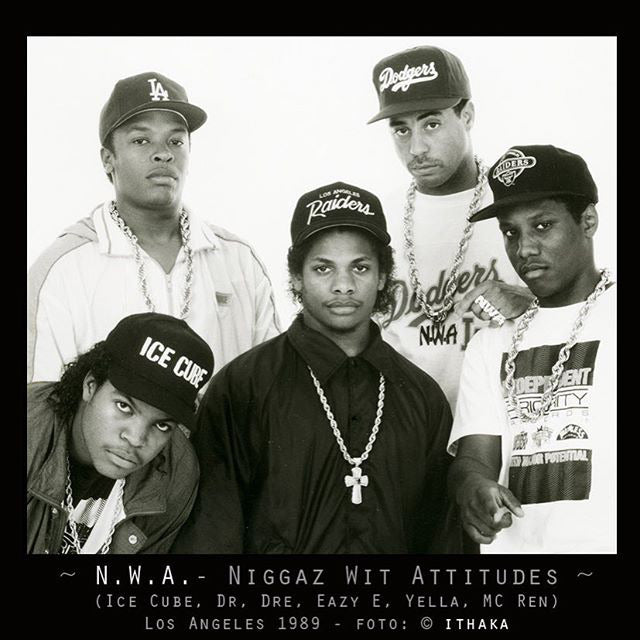
This first session between subjects and photographer was primarily intended to create the record cover for the 12" vinyl cover of Eazy E's "We Want Eazy" (shot at Ithaka's own apartment, in Miracle Mile, Los Angeles) followed by a quick publicity photo-shoot of all of N.W.A.'s five principal members; Dr. Dre, Eazy E, Ice Cube, MC Ren & DJ Yella. From this second part of the shooting, one of the most iconic images of N.W.A. appeared, now known as "The Miracle Mile Shot".

The Miracle Mile Shot: November 11th 1988

The Miracle Mile Shot, captured in late 1988, was used as the official press photo for N.W.A.'s double-platinum album, Straight Outta Compton. It was subsequently printed in hundreds of newspapers and magazines during 1989 (the year of the album's release), most importantly on the May 1989 cover of The Source to illustrate the article, "California Rap Hits Nationwide!".
Since 2013 (the 25th anniversary of Straight Outta Compton) the image has been republished in Rolling Stone, Q Magazine (UK), The Hundreds, Mass Appeal (media),<ref>http://massappeal.com/contact-high-ithaka-darin-pappas-on-photographing-a-bulletproof-vest-wearing-skateboarding-riding-eazy-e/</ref> Los Angeles (magazine), Los Angeles Times, Blitz Magazine (Portugal) etc., and was used as the primary backdrop for the entire NWA segment of the 2016 Rock and Roll Hall of Fame induction ceremony in Brooklyn, New York (state).<ref>http://www.digitalspy.com/music/news/a790016/ice-cube-and-dr-dre-join-nwa-members-in-brooklyn-as-they-are-admitted-to-rock-roll-hall-of-fame/</ref> The Miracle Mile Shot was used as the DVD cover of the 2015 documentary, Kings Of Compton. The Miracle Mile Shot also appears in the 2017 HBO documentary, The Defiant Ones, about Dr. Dre and Jimmy Iovine directed by Hughes brothers. <ref>https://www.rollingstone.com/music/news/dr-dre-jimmy-iovine-the-defiant-ones-doc-to-air-on-hbo-w454821</ref><ref>http://hiphopgoldenage.com/artists/n-w-a/</ref>

Eazy E Skateboarding In Venice Beach, California: February 24, 1989

Of the thousands of images that Ithaka captured during this period, some of the most unusual were made on February 24, 1989 of a bullet-proof vest wearing Eazy E riding a skateboard in Venice Beach, California and hanging out with the local skateboard community. At the time, skating and hip hop were not very linked culturally.
The day the skate images were captured was during a filming of a segment of Yo! MTV Rapshosted by Fab Five Freddy focusing on Eazy E and N.W.A. Other hip hop recording artists such as Above the Law (group), The D.O.C. and Kris Kross also appeared as special guests of N.W.A.<ref>https://www.generaladmission.us/blogs/news/eazy-e-and-ithakas-iconic-photo</ref><ref>http://massappeal.com/contact-high-ithaka-darin-pappas-on-photographing-a-bulletproof-vest-wearing-skateboarding-riding-eazy-e/</ref>
Eazy E, being a skateboard enthusiast, wandered off from the MTV interview to talk with local hardcore skaters near the riding area. Ithaka followed him and gathered everyone together to take several pictures. Among the kids alongside of Eazy E in the photographs appear several now-famous skaters, artists and photographers including; Aaron Murray, Ricky Reynaga, Barnall Weathersby, David Katz, Luke Hudson, Josh Bagel Klassman and Pep Williams. By most members of the skateboard world, this picture is considered historic. One of these images has become a top-selling T-Shirt produced by Thrasher (magazine), a leading international skateboard publication, and has also been used in advertising and other merchandising. In addition, this same photograph has appeared in international photography exhibits involving skateboarding including the group show, "Thrasher: A Retrospective", hosted by House Of Vans London (U.K.) in August of 2014. <ref>http://uk.complex.com/style/2014/08/house-vans-london-presents-new-exhibition-thrasher-retrospective</ref> <ref>https://www.skatedeluxe.com/en/thrasher-venice-sweatshirt-black_p90483</ref> <ref>http://onlytherealestblog.tumblr.com/post/114722544616/eazy-e-chillin-with-skaters-venice-tbt-ripeazye</ref>
However, the photographs of Eazy E actually riding the skateboard had been lost since they were made and only recovered in 2016, after more than two-and-a-half decades. Since reappearing, these very rare images of Eazy E have appeared in various venues. One was used during N.W.A.'s segment at the 2016 Rock and Roll Hall of Fame induction ceremony in Brooklyn, New York (state). In December 2016, the same image was printed on the cover of the first edition of the magazine General Admission (U.S.) <ref>https://www.generaladmission.us/blogs/news/eazy-e-and-ithakas-iconic-photo</ref> and in early 2017 other photos were published as part of the Contact High Project created by journalist Vikki Tobak in Mass Appeal Magazine.<ref>http://massappeal.com/contact-high-ithaka-darin-pappas-on-photographing-a-bulletproof-vest-wearing-skateboarding-riding-eazy-e/</ref>
To celebrate 2016's international Go Skateboarding Day, the official instagram of Beats By Dre, <ref>https://theundefeated.com/allday/go-skateboarding-day/</ref><ref>http://nwafotosbyithakadarinpappas.blogspot.com/2016/06/eazy-e-beats-by-dre-instagram-june-2016_25.html</ref> owned by Beats Electronics/Apple Inc. licensed an image of Eazy skateboarding for a six month usage. The Eazy E skateboarding pictures have also appeared on hundreds of other websites around the world. <ref>http://theridechannel.com/news/2016/01/eazy-e-skateboarding-photo</ref><ref>http://www.feelnumb.com/2016/02/07/skateboard-e-n-w-a-gangsta-eazy-e-skating-venice-beach-1989/</ref><ref>https://www.reddit.com/r/OldSchoolCool/comments/42z1wi/eazye_skateboarding_in_venice_beach_1989/</ref><ref>http://9gag.com/gag/aDo1DAB/eazy-e-skateboarding-in-venice-beach-1989</ref><ref>http://entimports.com/2016/02/12948/</ref><ref>http://www.rimasebatidas.pt/as-historicas-fotos-dos-n-w-homem-as-tirou-ligacao-portugal/</ref>

MacArthur Park, Los Angeles: March 11, 1989

One of the premier sessions between Eazy E, N.W.A. and photographer Ithaka Darin Pappas took place on March 11, 1989 at MacArthur Park near downtown Los Angeles. MacArthur Park, during that time, was considered an extremely dangerous place, with a reported 30 murders committed within the grounds in 1989 alone.<ref>https://prezi.com/mkmtqxlu_zgw/macarthur-park/</ref>
The session was suggested to be a simple documentation of an interview that was being filmed of the artists, but while waiting for the video crew to arrive, Ithaka proceeded in capturing a quick group portrait session on the bleacher-seating of the Levitt Pavilion, consisting of a two rolls of film. These images would later appear in several pages of Spin Magazine, a full-page ad in Billboard Magazine and on the cover of both the U.S. and U.K. editions of the "Express Yourself (N.W.A song)" maxi-single (which also features the track "A Bitch Iz A Bitch" and an extended remix of the song, "Straight Outta Compton"). <ref>https://rateyourmusic.com/release/single/n_w_a/express_yourself___straight_outta_compton___a_bitch_iz_a_bitch_f1.p/</ref> <ref>http://www.complex.com/style/2014/08/rappers-who-debuted-with-original-style/nwa</ref>

Eazy E and Daughter Erica Wright in Los Angeles: March 19, 1989

Photographed during an autograph session at a Wherehouse Records in Korea Town (LA), Ithaka Darin Pappas made several images of Eazy E and young daughter, Erica Wright, offering a rare 'loving' glimpse into the personal family life of a performer known publicly to be a ruthless villain. <ref>http://www.bet.com/music/2016/10/15/eazy-e-s-daughter-is-looking-for-answers-about-her-father-s-deat.html</ref>

Backstage in Phoenix: Summer 1989 (The end of the original N.W.A.)

In early summer of 1989, Ithaka was the only photographer invited to a private backstage Straight Outta Compton Tour ceremony in Phoenix, Arizona where Eazy E and N.W.A. were presented platinum plaques to signify 1,000,000 albums sold of both Straight Outta Compton and Eazy-Duz-It.<ref>https://books.google.com/books?id=0T5UCwAAQBAJ&pg=PT103&lpg=PT103&dq=nwa+arizona+1989+tour&source=bl&ots=OavAmNXCm7&sig=e6mNaGvuXrkIIaNq_FifhrbFOb0&hl=es-419&sa=X&ved=0ahUKEwjs_pCC17HRAhVH6oMKHd2eCNoQ6AEIRjAI#v=onepage&q=nwa%20arizona%201989%20tour&f=false</ref> This was same night Ice Cube opted not to sign a long-overdue exclusive contract with Priority Records, essentially breaking up N.W.A.'s original format as a group.
One of these images was published for the first time in Q Magazine (UK) in 2016 and then in the official event program book of the 2016 Rock and Roll Hall of Fame induction ceremony, followed by many other publications. <ref>https://books.google.com/books?id=H2smoEE3BuUC&pg=PA48&lpg=PA48&dq=nwa+US+tour+1989+phoenix&source=bl&ots=IOdh6Ce7ld&sig=wwLBzvSYkMscW_VeR664cvtaGlA&hl=es-419&sa=X&ved=0ahUKEwiX0uPd1rHRAhXm3YMKHWW_BngQ6AEIPDAD#v=onepage&q=nwa%20US%20tour%201989%20phoenix&f=false</ref>

Media uses

Record covers

Films & documentaries

Group exhibitions

Ceremonies

  • 2016 Rock and Roll Hall of Fame induction ceremony in Brooklyn, New York (state). Several Images by Ithaka Darin Pappas appeared as a backdrop for the N.W.A. segment and in official program book

Magazines, newspapers & websites

Books

  • 2016 Official Program Book for Rock and Roll Hall of Fame induction ceremony, Brooklyn, New York (state)
  • 2017 Beyond South Central (1988-1991) Hip hop photography book

Advertisements and promotional material

  • 1989 Billboard Magazine Full-page ad congratulating N.W.A. on 1,000,000 records sold

Interviews of the photographer about the pictures

References

Notes

External links


Category:Gangsta rap Category:Hip hop Category:Hip hop groups Category:Gangsta rap groups Category:Gangsta rappers Category:West Coast hip hop Category:N.W.A Category:Eazy-E Category:Skateboarding Category:Photojournalism Category:Hip hop media Category:Hip hop books

Tuesday, December 4, 2018

New works from California artist, Ithaka (Ithaka Darin Pappas)


Links:
https://www.discogs.com/artist/468212-ITHAKA
https://www.youtube.com/channel/UCIZXy50yj_t9UuHqeOQhpGQ
http://planetithaka.blogspot.com/
https://genius.com/artists/Ithaka
https://en.wikipedia.org/wiki/Ithaka_Darin_Pappas
http://ithakaofficial.com/
https://www.facebook.com/IthakaBlue/
https://itunes.apple.com/us/artist/ithaka/69363540
https://store.cdbaby.com/artist/Ithaka2
https://www.instagram.com/_ithaka_/?hl=en
https://www.imdb.com/name/nm5225987/
https://thehundreds.com/blogs/content/ithaka-interview
https://pt.wikipedia.org/wiki/Ithaka


http://upmagazine-tap.com/en/pt_artigos/ithaka-2/

Monday, November 26, 2018

Vocalist/Lyricist Ithaka Returns to the Microphone in 2019


Ithaka (Ithaka Darin Pappas)
portrait on the microphone in Lisbon, Portugal


Links:
https://www.discogs.com/artist/468212-ITHAKA
https://www.youtube.com/channel/UCIZXy50yj_t9UuHqeOQhpGQ
http://planetithaka.blogspot.com/
https://genius.com/artists/Ithaka
https://en.wikipedia.org/wiki/Ithaka_Darin_Pappas
http://ithakaofficial.com/
https://www.facebook.com/IthakaBlue/
https://itunes.apple.com/us/artist/ithaka/69363540
https://store.cdbaby.com/artist/Ithaka2
https://www.instagram.com/_ithaka_/?hl=en
https://www.imdb.com/name/nm5225987/
https://thehundreds.com/blogs/content/ithaka-interview
https://pt.wikipedia.org/wiki/Ithaka


http://upmagazine-tap.com/en/pt_artigos/ithaka-2/

Monday, November 19, 2018

BLAZEDMADE INTERVIEW: ITHAKA DARIN PAPPAS (PART 1/2)

BLAZEDMADE INTERVIEW: ITHAKA DARIN PAPPAS (PART 1/2)

BLAZEDMADE INTERVIEW: ITHAKA DARIN PAPPAS (PART 1/2)
August 31, 2018
Welcome to The Blazedmade Interview. Here we bring you exclusive, intimate and engaging conversations with those who live at the intersection of hip-hop, fashion and culture. From artists and producers to choreographers and creative directors, we pull back the curtain on raps' icons and unsung heroes, past and present.
We’re thrilled to kick things off with Ithaka Darin Pappas, who in 1988, was annointed N.W.A's official photographer by the groups label/distributor Priority Records.
Blazedmade founder Daniel Cutler spoke with Ithaka at his home in L.A. where the photographer-artist-surfer detailed the unknown story behind his iconic N.W.A "Miracle Mile” shot, an increasingly important image in the history of hip-hop. 
The two also discussed the day skateboarding went gangsta rap, and how, unbelievably, over 70% of Ithaka's N.W.A photos have never actually been seen. 
BM: Where are you from and where did you grow up? 
IDP: I’m from southern California, lived between and LA and Orange Country most of my life. 
BM: When did you start getting in to photography? 
IDP: I’ve always been in to it. My dad was a devout hobbyist, I’ve been shooting photos since I was five years old. I sold my first picture when I was 17 years old. 
BM: Who for? 
IDP:  Independent - a skateboard brand. In 1984 I think.
BM: Sure I know Independent. Did you skate?  
IDP: I’m a surfer. I was really just photographing skateboarders. I skate but I was much more behind the camera in that activity, whereas in surfing I was not behind the camera at all. 

N.W.A Miracle Mile photographed by Ithaka Darin Pappas, Los Angeles, 1988.
BM: What is this photo known as? When and where was it taken? 
IDP: This photo is known as The Miracle Mile. It was my first time photographing N.W.A and my first time shooting for Priority Records. It was intended to be the shoot for the cover of Eazy-E’s single “We Want Eazy". We were also trying to get publicity photos of N.W.A, as a group, which I didn’t get a whole lot of that day. We were also doing some publicity photos for Big Lady and she came by the shoot also. 
BM: As in Big Lady K? 
IDP: Yeah. She’s a rapper, half-Guatemalan, half-black from Riverside. She was fifteen at the time. An amazing talent. 
There was no directing anybody. They come self-contained. You can pare down the shoot to a point, but everybody's individual personality is so strong, they're not very moldable. 
BM: How did you land the gig? How did you connect with Priority? 
IDP: It was completely by coincidence. I was already shooting stuff in the entertainment world, mostly young, teeny bopper stuff. I was looking for something edgier. One day I was skateboarding down my street, in an area known as the Miracle Mile, and a neighbor of mine pulls up in the driveway next to mine with a ton of groceries, and I asked if she needed some help. It turned out to be one of the Marketing Directors at Priority. She invited me to go show my book to the Art Director over there. So the next week I went in to show my book to the director, Elaine Friedman, and it worked out. 
BM: That’s so random. 
IDP: Yeah - and I was totally an N.W.A fan. Gangsta Gangsta was blowing up K-Day which was the main radio station at the time. I mean, I was really listening to this stuff a lot. Then suddenly these guys (N.W.A) were in my living room a couple weeks later. It was pretty cool. 
BM: What year was this? 
IDP: This was November of 1988, I think it was November 11th. It was around the near simultaneous release of Straight Outta Comptonand Eazy’s first album (Eazy-Duz-It), they came out almost the same time. It was like a grand slam, it was pretty crazy, they were everywhere!

Eazy-E, Big Lady K and N.W.A "Miracle Mile" Contact Sheet, courtesy of Ithaka Darin Pappas.

BM:  Yeah, they were released a month apart I believe.
IDP: Yeah, I just remember Eazy and everybody rolling up to my place, which was in a really quiet semi-elderly Jewish neighborhood. They roll up in a GMC Safari, and they were just blasting the music! The neighbors were like “what’s going on?” It was great because I couldn’t stand my landlord at the time. 
BM: Ha! No one’s going to mess with you in that scenario.  
DP:  Yeah, yeah. It was fun.
BM: Where on the N.W.A timeline did the Miracle Mile shoot take place? Were they mostly an L.A. thing at this point? Or was it bigger than that? 
IDP: Well, I was only in L.A. so I don’t know. But in L.A. they were absolute underground legend status already. I don’t know how much mainstream people really knew about them, but in my world they were already household names after just six or seven months. [Ithaka chooses his words carefully] It was just such a raw…I think the thing that set this project apart…people that live in the suburbs were really aware of…I heard Cube say like a hundred times that N.W.A were street reporters, and nothing could be more accurate. At that time, all the violence happening was really behind the curtain. N.W.A brought us this slice of another reality, their reality, and it was really eye opening for a lot of people, myself included. 
BM: Yeah, me too. So explain how the shoot went down. Did they hand over the reigns to you as the director? Did they take your direction?
IDP: There was no directing anybody. They come self-contained. You can pare down the shoot to a point, but everybody’s individual personality is so strong, they’re not very moldable. It was their time, it was their world. I was more a fly on the wall, trying to capture what they were all about. I was trying to record who they were. 
BM: So this iconic image of gangsta rap's founding fathers was shot in your apartment? 
IDP: Yeah, at 65** 1/2 Orange Street, L.A., Wilshire and San Vincente. Near the Museum Row area. They just came over. One thing I had noticed, even at this early point, was that there weren’t a lot of clean shots of them together. They were either riding, in the street, on the move, in sunglasses. It was hard to see what they looked like. For this shoot, I was just trying to show their faces. Like I was shooting for a fashion magazine. It was shot in my apartment with a couple of studio strobe heads. I had rented a Hasselblad camera, a high end camera. These were smaller budget shoots, the entire budget for that day was maybe five hundred dollars and that was to include film and everything. I spent way more than that because I wanted to do a good job. These were people whose music I loved and people who I admired. I didn’t know if I was ever going to shoot them again. I wanted to do a kick-ass job first time around. 
BM: So you sensed that this could be a game changer for your career?  
IDP: Yeah, I mean I had no idea they were going to blow up to become, you know, millennial figures. I had no idea it was going to go that large, but I knew this was something special. 
BM: So what where they like? Describe their individual vibes.
DP: They were definitely tough guys, but also very funny, especially amongst themselves. Super funny cats. 
BM: Yeah, I hung out with Eazy a couple times and he was fucking funny! I don’t think people realize how huge a role humour played in his personality.
IDP: Yeah, Eazy had an incredible sense of humor. He had absolute star quality. And he was also extremely easy to photograph. Out of the entire group he was the easiest. I mean he was so stylized, and he was just easy to work with. I found Dre to be pretty shy, photographically. Eazy was a clown, a funny guy. Ren was really tough. Yella was really nice. Cube was serious and determined, his intelligence absolutely permeated, really obvious, I could tell how high the guys IQ was after just a three minute conversation. Then I think we ended getting a bunch of nachos and drank old English. It got loud, it was fun. 
BM: What was your relationship like with the guys at the start? 
DP: (Laughing) No one really remembered my name.They just called me “the camera man”. 
BM: I guess it’s obvious why.
DP: Well, we were shooting and the music was on, it was really loud. I was kind of standing on a stool, dancing to the music a bit, and Ren kinda pointed at me and smiled and said “check out the cameraman”. From then on i was “the cameraman”. I don’t think anybody called me anything but that from then on.
BM: How many sessions did you shoot with N.W.A? Over what period of time? 
DP: Well beginning in ’88 and ’89’, ’90...and I shot Ice Cube I think in ’91. So I would say three years. Photographing them every two months. I would say it was a about three years. I think eighteen to twenty shoots total.
BM: Wow. So you had this access to them from the very start, through their break-up, and afterwards? 
DP: Yeah and that was interesting too, because you know, arriving that first day, there was probably some live shows, nobody was really getting paid yet. Then two months later, people are driving nice cars. It was interesting to see it from a distance. I didn’t consider myself a friend, we didn’t really hang out, other than the Malibu “Wild and Wet party” but I would see them periodically and they were really getting famous so i would see, not really a difference in behaviour, but the accessories got a lot nicer! 
BM: No doubt! So over the period that you shot them they were going through a lot of internal conflict. Were they still together the last time you shot them? 
IDP: No, the last time I worked with N.W.A as a group Cube had already split. I worked with Cube a few times on his own projects, for video shoots and UK music magazines. That was as far as I got, I didn’t see Dre leave the group. I had moved back to Portugal by that time. 
BM: Did you shoot Dre solo as well? 
IDP: Not really. I mean I shot him by himself as a member of N.W.A. I would always pull people aside for little shoots. I did that with Dre. It was very improvisational. The one record cover that I shot, the only time we ever really had a layout, was for the We Want Eazy 12” cover. Everything else was “go out with the guys, get what you get".  One of those images, a bleacher shot in McArthur Park, ended up as the cover for the Express Yourself (single) and Straight Outta Compton maxi-single cover. Mostly I would just try to pull people aside and get a few shots. In a way it kind of dictated my whole style of photography from then on, because I was so limited on time with everybody that it made me work faster and try to come up with things on the fly that professionally looked like studio set-ups but with natural light and trying to keep a wall, you know, so I’m kind of thankful for that experience. It was like guerrilla shooting. 
BM: What equipment were you shooting on over those eighteen shoots? Was it one main camera? 
IDP: I shot the Miracle Mile image on medium format Hasselblad. Most of the other shoots were on Nikon 250 FE, you know just a standard camera. It was photojournalism. I was just trying to get portraits. But that first shoot (Miracle Mile) I shot that on medium format ultra high quality. It was a camera I used for my actor shoots, I was already familiar using it in the studio so that’s what I brought to that shoot. I rented all the gear and we shot it in my living room. 
BM: You also shot a series of photos with Eazy-E in Venice, skateboarding, which have become quite iconic. Can you tell me about those? 
END PART ONE.

Source: https://blazedmade.com/blogs/news/interview-ithaka-darin-pappas
Links:
https://www.discogs.com/artist/468212-ITHAKA
https://www.youtube.com/channel/UCIZXy50yj_t9UuHqeOQhpGQ
http://planetithaka.blogspot.com/
https://genius.com/artists/Ithaka
https://en.wikipedia.org/wiki/Ithaka_Darin_Pappas
http://ithakaofficial.com/
https://www.facebook.com/IthakaBlue/
https://itunes.apple.com/us/artist/ithaka/69363540
https://store.cdbaby.com/artist/Ithaka2
https://www.instagram.com/_ithaka_/?hl=en
https://www.imdb.com/name/nm5225987/
https://thehundreds.com/blogs/content/ithaka-interview
https://pt.wikipedia.org/wiki/Ithaka


http://upmagazine-tap.com/en/pt_artigos/ithaka-2/

Monday, November 12, 2018

Agora "Recorded In Rio" o novo álbum de Ithaka

Agora Recorded In Rio
por Vanessa Rato
__________________________________________________
Estava-se em 1982. A sete anos do fim da Guerra Fria, com George Bush pai na Casa Branca e ainda em plena demonização do espectro soviético, os Estados Unidos preparavam-se para a inauguração, em Washington, do mural de homenagem aos mortos do Vietname - 150 metros de granito preto para mais de 58 mil nomes, o balanço de uma das mais desastrosas opções da política externa norte-americana.
Em plena era de explosão informática, depois de Ronald Reagan e Lech Walesa, a revista "Time" escolhia como Pessoa do Ano nem mais nem menos que o computador pessoal da IBM. Era o ano de "E.T." e "Tootsie". Michael Jackson, em época de ouro, lançava "Thriller". Os Blondie atacavam com "The hunter" e os Clash com "Rock the Casbah". Entretanto, em Los Angeles, três colegas de liceu em plena adolescência testavam a mão numa especialidade menor do pequeno crime, o "Dine'n'Dash".
Começaram por acaso. Um dia, depois de uma sessão particularmente longa de "surf", acabaram a comer juntos num "buffet" chinês onde, no fim, ninguém parecia interessado em receber a conta. Vinte minutos de espera mais tarde, a opção foi sair sem pagar. Inesperadamente, ninguém os seguiu.
Poderia ter sido o princípio de uma espiral em direcção ao abismo de uma casa de correcção juvenil. E na verdade foi, mas apenas para um deles. Acontece que isso seria outra história. O que interessa: três semanas depois do "buffet" chinês, sempre a sacudir areia dos pés e com água a estalar nos ouvidos, o grupo estava a repetir a proeza de almoçar fora de graça a ritmo diário e com técnica apurada. Até que no Bob's Big Boy se cruzaram com uma rapariga chamada "Rita".
em fuga. Não é fácil escapar a uma empregada de mesa que é ex-corredora de fundo, sobretudo quando ela é do tipo de mulher por quem, na verdade, um adolescente prefere mesmo deixar-se apanhar - para aquele a quem importa aqui seguir o rasto, foi o fim de uma carreira no crime, mas, em compensação, o princípio de uma história de amor-até-que-qualquer-coisa-nos-separe e um passo na direcção de um percurso nas artes.
Passaram-se mais de duas décadas. É com este recorte de memória (na primeira pessoa e com muito daquilo a que os britânicos chamariam "humor de guilhotina") que arranca "Recorded in Rio", o quarto álbum do projecto Ithaka - 15 faixas de hip-hop "old school" com incursões pela soul e um "todos-sabores" electro, blues, jazz, reggae e ambiências latinas (Brasil em fantasma, mas também México) com eco de banda sonora sobre "spoken word".
O CD (não, ainda não sabe quando nem por quem será lançado em Portugal, mas está garantido que sairá depois do lançamento nos EUA pela OP, da Warner) chegou por correio com carimbo californiano, mas não veio sozinho. A acompanhá-lo, um pormenorizadissimo dossier com tudo o que se possa querer saber sobre o "background" e processo evolutivo de cada um dos temas.
Aparentemente, não há nada a esconder - é o lema "live it, write it, rap it": "Os artistas que eu admiro não são sequer, se calhar, os que têm melhores resultados. Interessam-me os processos, por isso gosto de pessoas que não têm medo de se expor. A pessoa média tem tanto medo de se mostrar que a podemos conhecer durante anos sem realmente saber quem é", diz o próprio "Fish Daddy" Ithaka Darin Pappas.
Para ilustrar a ideia, não dá um exemplo, faz menção a um verdadeiro ídolo: "Veja-se o Bukowski. Pode-se pensar: é uma merda! Mas é a merda dele. É um trabalho absolutamente honesto. Isso é o mais importante."
(Aparte absolutamente fiável: em 1996 alguém deu a ouvir o tema "Umbilibus" de "Flowers and the Color of Paint" à viúva do escritor; ela gostou tanto que ao saber que Pappas era um fã lhe mandou um pacote com vários livros e uma preciosa camisa azul ainda cheia de nódoas de vinho - ele nunca a lavou, "para não perder a alma" e continua a vesti-la de vez em quando).
in Portugal. São 9h45 em Portugal continental, oito horas menos na California, ou seja, 2h45 - tarde para quem acorda às 7h para apanhar as praias vazias e as melhores ondas. Mas não é por isso que, do outro lado da linha, Pappas arrasta a voz e enrola as palavras. Ele fala assim, para dentro, como quem rumina o que diz, numa "coolness" temperada entre West Hollywood, Korea Town, as praias de South Bay e, basicamente, qualquer canto recôndito do planeta que venha à memória.
O termo "globe-trotter" seria um bom atalho para falar das suas deambulações mundiais, não fosse dar-se o caso de lhe ficar tão mal. É que, contrariamente àqueles que se deixam catapultar de lugar em lugar, com motor de auto-propulsão à beira da implosão, Pappas gosta de se demorar nos sítios por onde passa. Foi assim que acabou por ficar por Lisboa quase seis anos.
Para os mais esquecidos: a chegada foi em 1992 e a partida só em 98, pelo meio ficaram dois álbuns, "Flowers and the Color of Paint" (1995) e "Stellafly" (97), considerado por alguns como "o mais poderoso e consistente" registo nacional desse ano. Em termos musicais, entre muitas outras colaborações, ficou ainda a letra do internacionalizadíssimo "So get up" para os Underground Sound of Lisbon.
É o lado público. Há o privado: a aterragem com 70 dólares no bolso e o contacto de um obscuro advogado norte-americano a precisar de ver recuperada uma casa centenária no Bairro Alto.
"Em termos musicais, a minha vida artística nasceu em Portugal. Nunca tinha falado para um microfone. Na verdade, nunca tinha sequer visto o interior de um estúdio de gravação", diz Pappas. Fotógrafo e escultor, o músico-por-vir foi vivendo uma sucessão de "acidentes", em geral felizes.
Os encontros com General D, Boss AC, Yen Sung, Pedro Passos. "Ganzas", Super Bock e caldo verde. Está tudo em "Recorded in Rio": depois de "Dine'N'Dash" damos um salto de dez anos (que passa por cima de 18 meses em Tóquio) e, no segundo tema, "...in Portugal", o álbum de memórias abre-se no capítulo nacional. É um tributo "à minha segunda casa". O tom é nostálgico e a batida funk.
Não será o tema mais forte do álbum, mas isso é pouco relevante: tal como o anterior "Somewhere South of Somalia" (2001) - com o produtor-engenheiro Conley "Conman" Abrams (TuPac, Queen Latifa, Snoop Doggy Dog), que conta as então recentes aventuras na África Oriental -, "Recorded in Rio" é também mais um diário a viver página a página que uma cruzada pelo tema "punch". E tal como esse último, "Recorded..." é, como já se poderá ter adivinhado pelo seu título, fruto de (mais) uma etapa de viagens. A consequência: todo um novo conjunto de colaborações.
Sem rodeios: "Prefiro não ver as mesmas caras todos os dias", diz Pappas em "Technically a Failure" - "I split. Escape. Evaporate". O exagero é artístico, mas na "vida real" o tema do escapismo "beat" versão "remastered" persiste: "Não quero repetir experiências. Não imagino gravar num mesmo estúdio. O desconhecido traz uma energia muito particular, muito inspiradora."
Gabriel o Pensador era um amigo já dos tempos de Portugal e em 2001 a passagem por sua casa tinha contornos de viagem de lazer. Só que quando somos uma pequena máquina de produção independente e em auto-gestão a vida não se compartimenta de forma estanque.
"Nessa altura conheci muita gente e uma das coisas que mais me impressionou foi a maneira como no Brasil as pessoas ainda fazem as coisas por amor. Nada como em L.A., onde tudo é altamente profissionalizado."
Os colaboradores de ocasião foram aparecendo, quase por acaso, pelas instalações do estúdio Monoaural. E foram ficando: o próprio Grabriel o Pensador, Bnegão (Planet Hemp), a actriz e cantora Thalma de Freitas, os baixistas Liminha (Os Mutantes) e Alberto Continentino (Ed Motta), Pepe Cisneros (um "transplante cubano para o Rio), o baterista Cézar "Bodão" Farias (Lulu Santos e Fernanda Abreu), o teclista Claudinho Andrade (Gilberto Gil)...
A produção no Brasil ficou a cargo de Berna Cappas e em Los Angeles, de novo com Conley Abrams.
Foram quatro meses de trabalho de grupo a juntar aos outros quatro que Pappas já tinha passado a trabalhar a solo na Califórnia. Depois do assombrado "Muerto escondido", o terceiro tema do álbum, sobre uma passagem negra por Puerto Escondido, no México, onde "men walk on water e zombies walk the streets", o quarto tema fala dessa experiência brasileira: é uma adaptação do tema "Umbilibus" de "Flowers and The Color of Paint" (1995), uma rábula sobre artistas que aos 37 anos e com quatro álbuns, continuam a ter que andar de autocarro, mesmo no Brasil: "Yeah, right here on the mothafucking bus".

Saturday, November 10, 2018

How Vibe's "So Get Up" Put Portugal On The International Dance Music Map (lyrics/vocals by: Ithaka)


DJ VIBE & So Get Up documentary:
DJ Vibe began what would be a ten year residency at Kremlin. In the nineties, Kremlin was considered the third best club in the world and under Vibe's advice started hosting international appearances.


It was 1992 when Vibe was finally flown to New York City. By that time Lisbon had found a place on the world map of clubbing.

The Underground Sound Of Lisbon, a collaboration between Rui Da Silva and Vibe, started of with a track featuring Ithaka's (Ithaka Darin Pappas) voice and poetry. So Get Up was destined to become a perennial dance floor smasher.

Vibe's memory of New York was still vivid in his mind when he started producing So Get Up.
Vibe had just come back from the Big Apple, where he'd see Junior Vasquez play at the epic Sound Factory. He sent a test pressing of So Get Up to a friend in New York City and the record magically arrived in the very hands of Junior Vasquez who started playing the track at the Sound Factory.

One year later, Tribal America, a subsidiary of EMI Records released the single and it soon became a national anthem of Portuguese dance music.

The song climbed to 1st Place on the Billboard U.K. Independent Dance Music charts and the first international edition sold over 50,000 copies.


By the mid-90's, Vibe had become an international ambassador for Portugal's dance music scene.


Ithaka & DJ Vibe late 1993, Lisbon, Portugal

_____________________________ 

Versions have appeared (both legally and illegally by: Underground Sound Of Lisbon, Danny Tenaglia, Junior Vasque"SO GET UP"
THE END OF THE EARTH IS UPON US PRETTY SOON ITLL ALL TURN TO DUST SO GET UP FORGET THE PAST GO OUTSIDE HAVE A BLAST GO A THOUSAND MILES IN A JET AIRPLANE GO OUT OF YOUR MIND GO INSANE TO A PLACE YOU NEVER BEEN BEFORE EAT ICE CREAM OUR YOULL LICK THE FLOOR CUZ, THE END OF THE EARTH IS UPON US PRETTY SOON IT'LL ALL TURN TO DUST GOODBYE MY FRIENDS, GOODBYE WORLD I'LL SEE YOU IN THE NEXT LIFE

https://en.wikipedia.org/wiki/So_Get_Upz, Dubfire, Fat Bot Slim, Stretch & Verne, Cosmic Gate, Igor Carmo, Miguel Lemos, Ben Gold, Swing Kings, Wake Your Mind Records, Mowree, Igor Carmo, Rui Da Silva, Dani Sbert, Miss Kittin, JJ Mullor, Maik Ibane, Vendetta, Caos, Kaos, Supermarket, Nervous, Elektro Beats. Twisted Records, Tribal (UK), Tribal (USA) ----------------------------------------­-------------- Poem: "SO GET UP" © ithaka darin pappas (1993, 1994, 2014) Published by: Ravenshark music (Los Angeles) Scion four music (New York) -ASCAP (USA)- for licensing inquiries contact: heather trussell at scion four music heather@scionmusicgroup.com -------------------------------------- end credit intrumental: ithaka: "Roula's Revenge" from the album: voiceless blue raven (sweatlodge records) (available on itunes) ================================================ ================================================ SO GET UP (wikipedia) The "So Get Up" Controversy --------------------------------------- In 1993, Ithaka had originally written and recited the poem called So Get Up (The End Of The Earth Is Upon Us) for his weekly segment of a radio program called Quatro Bairro on Antena One in Lisbon, Portugal. The next year he rerecorded it as a guest performer to be the primary vocal of a B-Side single for the Portuguese dance music group called Underground Sound Of Lisbon. The song became an instant national hit and was later released internationally as a ten-mix, double vinyl set on New York's Tribal Records (a subsidiary of I.R.S. Records/E.M.I. Records). The song climbed to 8th place on the Billboard's Independent Dance Music Charts for the U.K. - and number 52nd in the United States. Since 1995, the song has been remixed a minimum of a hundred times including versions by such greats as Fat Boy Slim, Junior Vasquez, Danny Tenaglia, Cosmic Gate and has appeared on over fifty compilations with combined sales in the millions. As the original music has been stripped away by each succeeding producer, the only singularly unifying element of all 100+ mixes is Ithaka's poem and his vocals. Ironically, the song which was considered the first modern "Portuguese" musical export was released without even a "featuring Ithaka" credit even though Ithaka, a Californian who was only temporarily residing in Lisbon, was the primary publishing rights owner of the track and never a member of the Underground Sound Of Lisbon project. Reportedly no actual record royalties were ever paid to Ithaka.